
200-301 · Question #878
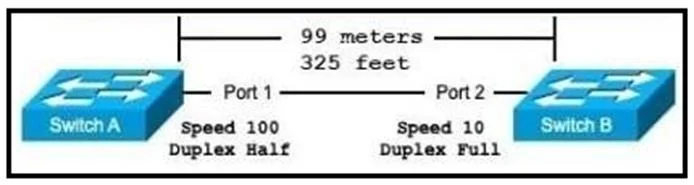
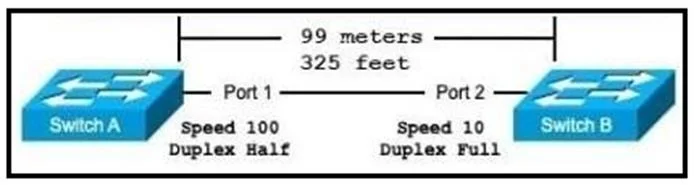
Refer to the exhibit. The switches are connected via a Cat5 Ethernet cable that is tested successfully. The interfaces are configured as access ports and are both in a down status. What is the cause…
The correct answer is A. The speed settings on the switches are mismatched. Simply put, it is due to electrical differences between 10, 100 and 1000 Mbit. When you use autonegotiation of speed, the ethernet controller can look at the characteristics of the incoming electrical signal to determine the speed of the link. When you manually specify the…
Question
Exhibits
Options
- AThe speed settings on the switches are mismatched
- BThe distance between the two switches is not supported by Cat5
- CThe switches are configured with incompatible duplex settings
- DThe portfast command is missing from the configuration
How the community answered
(46 responses)- A74% (34)
- B15% (7)
- C4% (2)
- D7% (3)
Explanation
Simply put, it is due to electrical differences between 10, 100 and 1000 Mbit. When you use autonegotiation of speed, the ethernet controller can look at the characteristics of the incoming electrical signal to determine the speed of the link. When you manually specify the link-speed, you disable the auto-negotiation mechanism and lock the interface to the specified speed. If the other end don't match the speed and thus having different electrical characteristics of the signal, the link won't come up. The most obvious difference is between 10M/100M and 1000M, which require all of the four available pairs in the patch cable, whereas 10M and 100M only uses two of
Topics
Community Discussion
No community discussion yet for this question.