
200-301 · Question #849
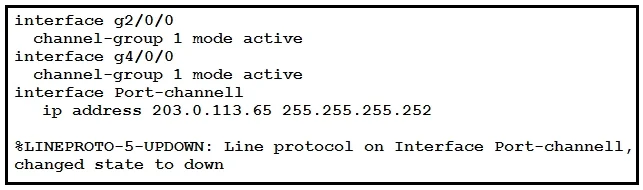
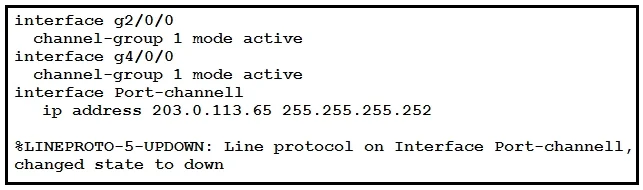
Refer to the exhibit. An engineer is configuring a Layer 3 port-channel interface with LACP. The configuration on the first device is complete, and it is verified that both interfaces have…
The correct answer is D. Modify the static EtherChannel configuration of the device to passive mode. To form an LACP port channel with a peer that has an LACP configuration, the neighboring device can be set to LACP passive mode to respond to negotiations without initiating them itself.
Question
Refer to the exhibit. An engineer is configuring a Layer 3 port-channel interface with LACP. The configuration on the first device is complete, and it is verified that both interfaces have registered the neighbor device in the CDP table. Which task on the neighbor device enables the new port channel to come up without negotiating the channel?
Exhibits
Options
- AChange the EtherChannel mode on the neighboring interfaces to auto.
- BConfigure the IP address of the neighboring device.
- CBring up the neighboring interfaces using the no shutdown command.
- DModify the static EtherChannel configuration of the device to passive mode.
How the community answered
(22 responses)- A5% (1)
- B9% (2)
- C23% (5)
- D64% (14)
Why each option
To form an LACP port channel with a peer that has an LACP configuration, the neighboring device can be set to LACP passive mode to respond to negotiations without initiating them itself.
The `auto` mode is associated with PAgP (Port Aggregation Protocol), not LACP, and still involves negotiation.
Configuring the IP address is a Layer 3 step for the port-channel interface, not the mechanism for establishing the EtherChannel bundle itself.
The `no shutdown` command activates the interface but does not determine the method of EtherChannel formation or negotiation.
If the first device is configured for LACP (e.g., `active` mode), configuring the neighbor device to LACP `passive` mode allows it to respond to LACP PDUs initiated by the first device, forming the channel without the neighbor itself initiating the negotiation process.
Concept tested: LACP EtherChannel modes and negotiation
Source: https://www.cisco.com/c/en/us/td/docs/switches/lan/catalyst9300/software/release/16-12/configuration_guide/lacp/b_1612_lacp_9300_cg/configuring_etherchannel_and_lacp.html
Topics
Community Discussion
No community discussion yet for this question.