
200-301 · Question #843
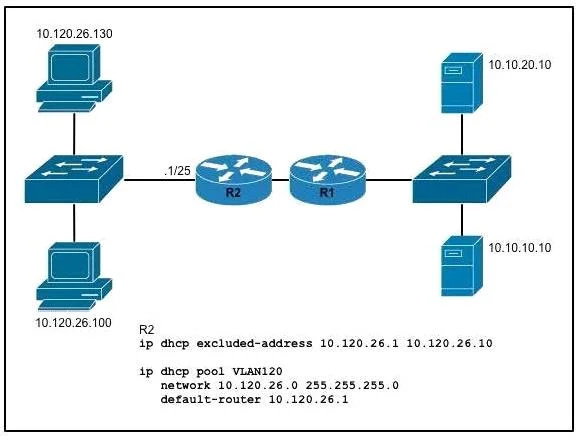
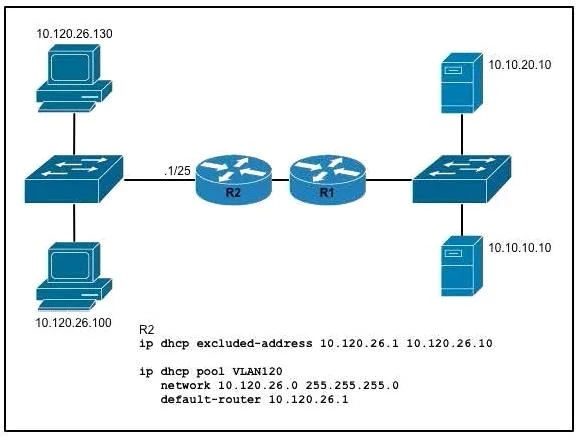
Refer to the exhibit. Users in your office are complaining that they cannot connect to the severs at a remote site. When troubleshooting,you find that you can successfully reach the severs from…
The correct answer is D. VLSM is misconfigured between the router interface and the DHCP pool. If users cannot reach remote servers but router R2 can, a likely cause is a VLSM misconfiguration between the users' network router interface and their DHCP pool, leading to incorrect IP addressing and routing for user devices.
Question
Refer to the exhibit. Users in your office are complaining that they cannot connect to the severs at a remote site. When troubleshooting,you find that you can successfully reach the severs from router R2. What is the most likely reason that the other users are experiencing connection failure?
Exhibits
Options
- Ainterface ports are shut down on the remote servers
- BThe DHCP address pool has been exhausted
- CThe ip helper-address command is missing on the R2 interface that connects to the switch
- DVLSM is misconfigured between the router interface and the DHCP pool.
How the community answered
(44 responses)- A7% (3)
- B14% (6)
- C25% (11)
- D55% (24)
Why each option
If users cannot reach remote servers but router R2 can, a likely cause is a VLSM misconfiguration between the users' network router interface and their DHCP pool, leading to incorrect IP addressing and routing for user devices.
Since router R2 can successfully reach the remote servers, the server interface ports are likely not shut down.
An exhausted DHCP pool would prevent users from obtaining IP addresses, leading to a complete lack of network access, which is a different symptom than being unable to connect to *remote servers* while R2 can.
A missing `ip helper-address` would prevent DHCP requests from reaching the DHCP server if it's on a different subnet, leading to users not getting IP addresses, rather than only being unable to reach remote servers.
If VLSM is misconfigured between the router's interface and the DHCP pool for the user subnet, user devices might receive IP addresses and subnet masks that prevent them from correctly routing traffic beyond their local segment, even if the router itself has proper connectivity to the remote servers.
Concept tested: VLSM and routing/subnetting issues
Source: https://www.cisco.com/c/en/us/support/docs/ip/ip-addressing/13606-21.html
Topics
Community Discussion
No community discussion yet for this question.