
200-301 · Question #661
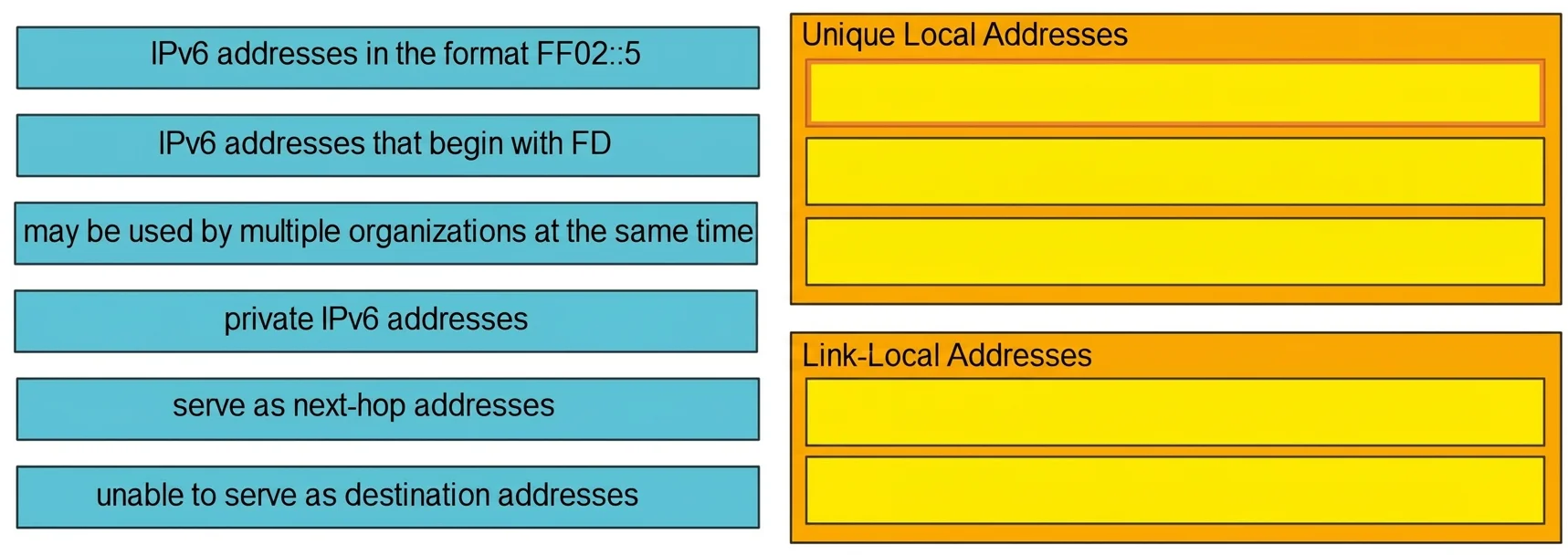
Drag and Drop Question Drag and drop the IPv6 address descriptions from the left onto the IPv6 address types on the right. Not all options are used. Answer:
The correct answer is IPv6 addresses that begin with FD; private IPv6 addresses; may be used by multiple organizations at the same time; serve as next-hop addresses; unable to serve as destination addresses. Unique Local Addresses (ULAs) begin with the prefix FC00::/7, but specifically those beginning with 'FD' (FD00::/8) are the commonly used subset, and they function as private IPv6 addresses analogous to RFC 1918 private IPv4 addresses. ULAs may be used by multiple organizations…
Question
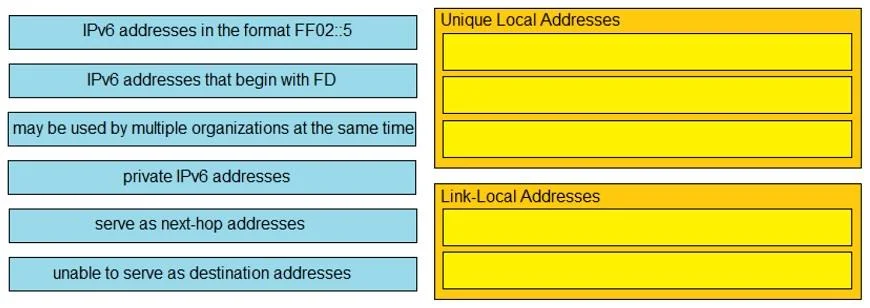
Drag and Drop Question Drag and drop the IPv6 address descriptions from the left onto the IPv6 address types on the right. Not all options are used. Answer:
Exhibits
Answer Area
Drag items
Correct arrangement
- IPv6 addresses that begin with FD
- private IPv6 addresses
- may be used by multiple organizations at the same time
- serve as next-hop addresses
- unable to serve as destination addresses
Explanation
Unique Local Addresses (ULAs) begin with the prefix FC00::/7, but specifically those beginning with 'FD' (FD00::/8) are the commonly used subset, and they function as private IPv6 addresses analogous to RFC 1918 private IPv4 addresses. ULAs may be used by multiple organizations simultaneously because they are not globally routable and not registered with IANA, meaning address collisions between organizations can occur. Link-local addresses (FE80::/10) serve as next-hop addresses in routing tables and are unable to serve as destination addresses in routed packets since they are confined to a single link segment.
Topics
Community Discussion
No community discussion yet for this question.