
200-301 · Question #662
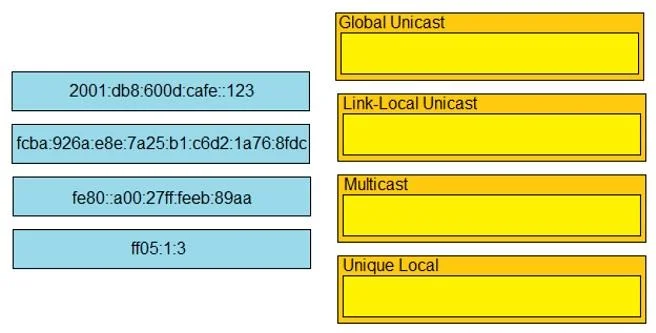
Drag and Drop Question Drag and drop the IPv6 addresses from the left onto the corresponding address types on the right. Answer:
The correct answer is IPv6 addresses that begin with FD; private IPv6 addresses; may be used by multiple organizations at the same time; serve as next-hop addresses; unable to serve as destination addresses. IPv6 Address Types - Drag-and-Drop Explanation This question maps characteristics to two IPv6 address types. The key is identifying the two types being described, then matching properties to each. --- The Two Address Types | Group | Address Type | Prefix |…
Question
Exhibit
Answer Area
Drag items
Correct arrangement
- IPv6 addresses that begin with FD
- private IPv6 addresses
- may be used by multiple organizations at the same time
- serve as next-hop addresses
- unable to serve as destination addresses
Explanation
IPv6 Address Types - Drag-and-Drop Explanation
This question maps characteristics to two IPv6 address types. The key is identifying the two types being described, then matching properties to each.
The Two Address Types
| Group | Address Type | Prefix |
|---|---|---|
| Items 1-3 | Unique Local Addresses (ULA) | FD00::/8 |
| Items 4-5 | Link-Local Addresses | FE80::/10 |
FF02::5 (multicast) is the distractor - it does not belong to either group.
Item-by-Item Breakdown
1. "IPv6 addresses that begin with FD" -> Unique Local
FD is the most common ULA prefix. ULA addresses (FC00::/7, split into FC and FD) are the IPv6 equivalent of RFC 1918 private space. FD specifically means the address was locally/randomly generated.
2. "private IPv6 addresses" -> Unique Local
ULA addresses are not routable on the public internet - they are the IPv6 analog of 10.x.x.x, 172.16.x.x, and 192.168.x.x. "Private" is the defining characteristic.
3. "may be used by multiple organizations at the same time" -> Unique Local
Unlike public IPv6, ULA addresses are not globally registered or coordinated. Two different companies can independently use the same FD address space internally without conflict - they're private and non-routable, so overlap doesn't matter.
4. "serve as next-hop addresses" -> Link-Local
Link-local addresses (FE80::/10) appear as next-hop entries in IPv6 routing tables. When a router advertises a route via OSPFv3 or RIPng, the next-hop is typically the neighbor's link-local address on that interface.
5. "unable to serve as destination addresses" -> Link-Local
Link-local addresses are scoped to a single link/segment. A packet destined for FE80:: cannot be forwarded by a router beyond that link - routers will not route packets with a link-local destination. They are only valid for on-link communication.
Why FF02::5 is the Distractor
FF02::5 is the OSPFv3 all-SPF-routers multicast address. It is neither private (ULA) nor link-scoped in the same way. It's a well-known multicast address used for OSPFv3 hello packets. Including it tests whether you confuse multicast with link-local or ULA.
Common Misconceptions
| Mistake | Correction |
|---|---|
Thinking FE80 can be a routed destination | Link-local addresses are non-routable; packets with FE80 destinations are dropped at router boundaries |
| Assuming ULA addresses are globally unique | They are designed to be random enough to avoid collisions, but they are not registered - overlap is possible in theory |
Confusing ULA with ::1 (loopback) | ::1 is loopback; ULA (FD) is for private network communication between devices |
Thinking FF02::5 is link-local | Multicast and link-local are different scopes; FF02 is link-scope multicast, not FE80 link-local |
Topics
Community Discussion
No community discussion yet for this question.