
200-301 · Question #655
Drag and Drop Question Drag and drop the TCP or UDP details from the left onto their corresponding protocols on the right. Answer:
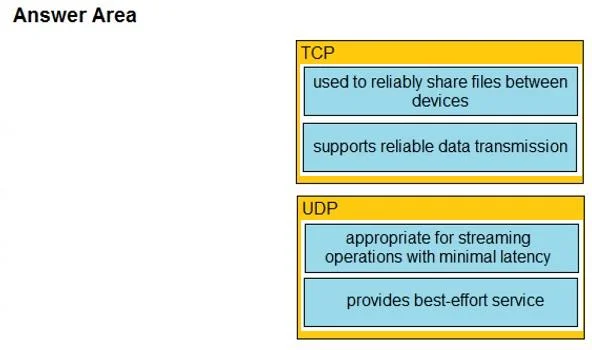
The correct answer is TCP; used to reliably share files between devices; supports reliable data transmission; UDP; appropriate for streaming operations with minimal latency; provides best-effort service. TCP (Transmission Control Protocol) is a connection-oriented protocol that guarantees delivery through acknowledgments, retransmission, and sequencing, making it ideal for reliably sharing files between devices and supporting reliable data transmission. UDP (User Datagram…
Question
Drag and Drop Question Drag and drop the TCP or UDP details from the left onto their corresponding protocols on the right. Answer:
Exhibit
Answer Area
Drag items
Correct arrangement
- TCP
- used to reliably share files between devices
- supports reliable data transmission
- UDP
- appropriate for streaming operations with minimal latency
- provides best-effort service
Explanation
TCP (Transmission Control Protocol) is a connection-oriented protocol that guarantees delivery through acknowledgments, retransmission, and sequencing, making it ideal for reliably sharing files between devices and supporting reliable data transmission. UDP (User Datagram Protocol) is a connectionless protocol that sends data without establishing a connection or guaranteeing delivery, making it appropriate for streaming operations where speed matters more than perfection and where best-effort service is acceptable. The key distinction is that TCP trades speed for reliability, while UDP trades reliability for low latency and speed.
Topics
Community Discussion
No community discussion yet for this question.