
200-301 · Question #654
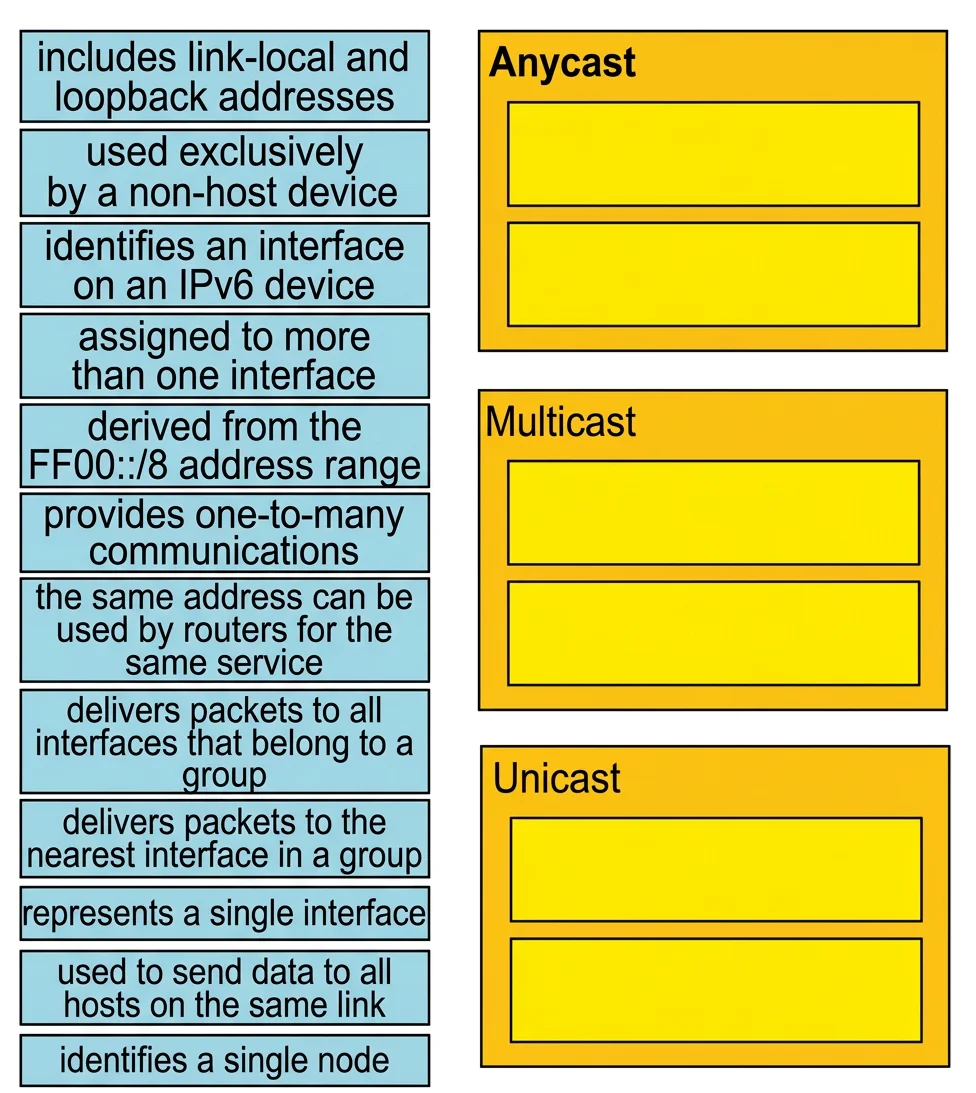
Drag and Drop Question Drag and drop the IPv6 address details from the left onto the corresponding types on the right. Answer:
The correct answer is used exclusively by a non-host device; assigned to more than one interface; derived from the FF00::/8 address range; provides one-to-many communications; includes link-local and loopback addresses; identifies an interface on an IPv6 device. IPv6 addresses are categorized into Unicast (identifies a single interface), Multicast (derived from FF00::/8, provides one-to-many communications, assigned to more than one interface), and Anycast (used exclusively by non-host/router devices). Unicast subtypes include…
Question
Exhibit
Answer Area
Drag items
Correct arrangement
- used exclusively by a non-host device
- assigned to more than one interface
- derived from the FF00::/8 address range
- provides one-to-many communications
- includes link-local and loopback addresses
- identifies an interface on an IPv6 device
Explanation
IPv6 addresses are categorized into Unicast (identifies a single interface), Multicast (derived from FF00::/8, provides one-to-many communications, assigned to more than one interface), and Anycast (used exclusively by non-host/router devices). Unicast subtypes include link-local (FE80::/10) and loopback (::1), which are special-purpose addresses. The FF00::/8 prefix is the definitive identifier for multicast addresses, and anycast addresses are syntactically identical to unicast but are assigned to multiple interfaces with packets delivered to the nearest one.
Topics
Community Discussion
No community discussion yet for this question.