
200-301 · Question #629
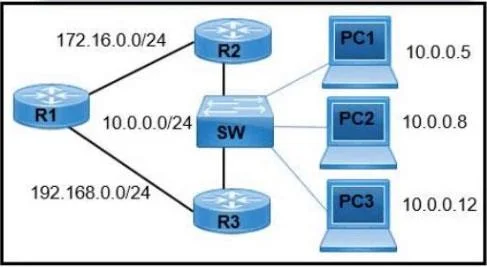
Refer to the exhibit. A network engineer must configure R1 so that it sends all packets destined to the 10.0.0.0/24 network to R3, and all packets destined to PC1 to R2. Which configuration must the…
The correct answer is C. R1(config)#ip route 10.0.0.0 255.255.255.0 192.168.0.2. To route packets for the 10.0.0.0/24 network to R3, R1 must be configured with a static route specifying the destination network 10.0.0.0, a subnet mask of 255.255.255.0, and R3's directly connected IP address (192.168.0.2) as the next hop.
Question
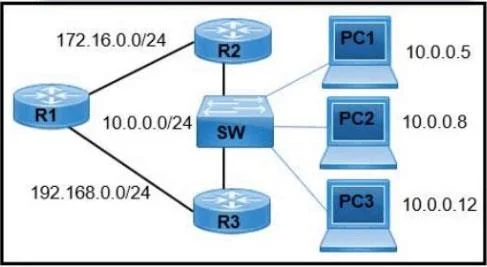
Refer to the exhibit. A network engineer must configure R1 so that it sends all packets destined to the 10.0.0.0/24 network to R3, and all packets destined to PC1 to R2. Which configuration must the engineer implement?
Exhibits
Options
- AR1(config)#ip route 10.0.0.0 255.255.255.0 172.16.0.2
- BR1(config)#ip route 10.0.0.0 255.255.0.0 172.16.0.2
- CR1(config)#ip route 10.0.0.0 255.255.255.0 192.168.0.2
- DR1(config)#ip route 10.0.0.0 255.255.0.0 192.168.0.2
How the community answered
(37 responses)- A5% (2)
- B8% (3)
- C73% (27)
- D14% (5)
Why each option
To route packets for the 10.0.0.0/24 network to R3, R1 must be configured with a static route specifying the destination network 10.0.0.0, a subnet mask of 255.255.255.0, and R3's directly connected IP address (192.168.0.2) as the next hop.
This command specifies 172.16.0.2 as the next-hop, which is not the correct IP address of R3 connected to R1 for routing the 10.0.0.0/24 network.
This command uses a subnet mask of 255.255.0.0, which corresponds to a /16 network, not the required /24 network, meaning it would route a larger range of IPs incorrectly.
The command `ip route 10.0.0.0 255.255.255.0 192.168.0.2` correctly defines a static route for the 10.0.0.0/24 network. It specifies the destination network, the exact subnet mask for a /24 network, and directs traffic to the next-hop IP address 192.168.0.2, which is R3's interface address connected to R1.
This command uses a subnet mask of 255.255.0.0 (a /16 network) and an incorrect next-hop of 192.168.0.2 (if the mask was intended to be /24), failing to meet the requirement for the 10.0.0.0/24 network.
Concept tested: Static IP routing configuration
Source: https://www.cisco.com/c/en/us/td/docs/ios-xml/ios/iproute_static/configuration/xe-3s/irs-xe-3s-book/irs-static-route-config.html
Topics
Community Discussion
No community discussion yet for this question.