
200-301 · Question #485
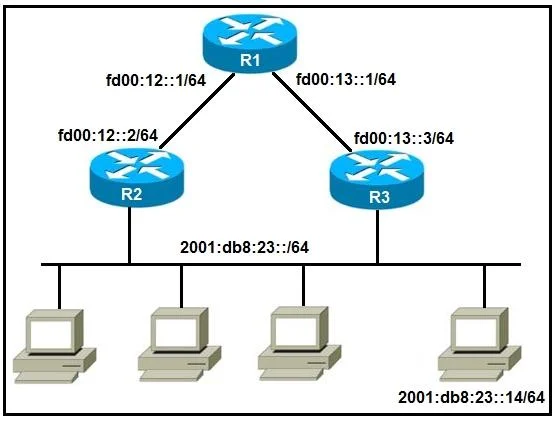
Refer to the exhibit. Which two commands, when configured on router R1, fulfill these requirements? (Choose two.) - Packets toward the entire network 2001:db8:23::/64 must be forwarded through…
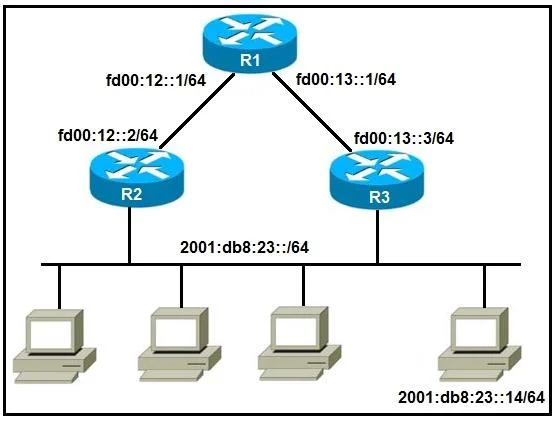
The correct answer is B. Ipv6 route 2001:db8:23::14/128 fd00:13::3 D. Ipv6 route 2001:db8:23::/64 fd00:12::2. Therefore, we use a host route meaning that all bits of the ipv6 destination address must match (prefix-length of /128). Also, the next hop address should be that of R3 (fd00:13::3) since the question asks that packets for the host must be forwarded through it.
Question
Refer to the exhibit. Which two commands, when configured on router R1, fulfill these requirements? (Choose two.)
- Packets toward the entire network 2001:db8:23::/64 must be forwarded
through router R2.
- Packets toward host 2001:db8:23::14 preferably must be forwarded
through R3.
Exhibits
Options
- AIpv6 route 2001:db8:23::/128 fd00:12::2
- BIpv6 route 2001:db8:23::14/128 fd00:13::3
- CIpv6 route 2001:db8:23::14/64 fd00:12::2
- DIpv6 route 2001:db8:23::/64 fd00:12::2
- EIpv6 route 2001:db8:23::14/64 fd00:12::2 200
How the community answered
(17 responses)- A6% (1)
- B65% (11)
- C24% (4)
- E6% (1)
Explanation
Therefore, we use a host route meaning that all bits of the ipv6 destination address must match (prefix-length of /128). Also, the next hop address should be that of R3 (fd00:13::3) since the question asks that packets for the host must be forwarded through it.
Topics
Community Discussion
No community discussion yet for this question.