
200-301 · Question #476
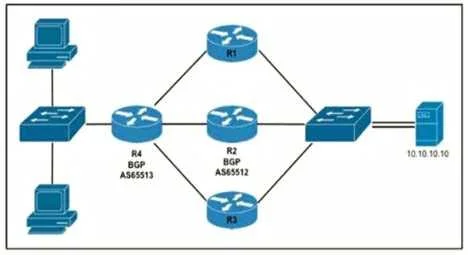
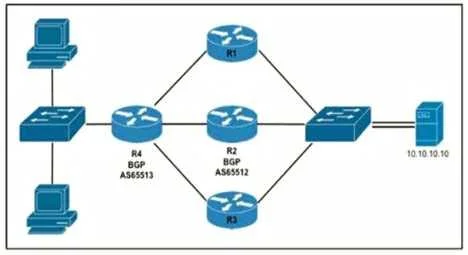
Refer to the exhibit. Router R4 is dynamically learning the path to the server. If R4 is connected to R1 via OSPF Area 20, to R2 via R2 BGP, and to R3 via EIGRP 777, which path is installed in the…
The correct answer is C. the path through R2 because the EBGP administrative distance is 20. The path through R2 will be installed in R4's routing table because EBGP has the lowest administrative distance (20) compared to OSPF (110) and EIGRP (90).
Question
Exhibits
Options
- Athe path through R1, because the OSPF administrative distance is 110
- Bthe path through R2. because the IBGP administrative distance is 200
- Cthe path through R2 because the EBGP administrative distance is 20
- Dthe path through R3. because the EIGRP administrative distance is lower than OSPF and BGP
How the community answered
(49 responses)- A12% (6)
- B2% (1)
- C80% (39)
- D6% (3)
Why each option
The path through R2 will be installed in R4's routing table because EBGP has the lowest administrative distance (20) compared to OSPF (110) and EIGRP (90).
OSPF's administrative distance is 110, which is higher than EBGP's AD of 20, so it would not be preferred.
Internal BGP (IBGP) has an administrative distance of 200, which is much higher than EBGP's AD, making it less preferred. The connection to R2 is typically EBGP unless specified as IBGP.
When a router learns multiple paths to the same destination from different routing protocols, it uses Administrative Distance (AD) to determine the most trustworthy path. External BGP (EBGP) has an administrative distance of 20, which is lower than OSPF's AD of 110 and EIGRP's (internal) AD of 90. Therefore, the path learned via EBGP through R2 will be preferred and installed in the routing table.
EIGRP (internal) has an administrative distance of 90, which is lower than OSPF and IBGP but still higher than EBGP's AD of 20, thus it would not be the preferred path.
Concept tested: Router Administrative Distance (AD)
Source: https://www.cisco.com/c/en/us/support/docs/ip/border-gateway-protocol-bgp/13768-4.html
Topics
Community Discussion
No community discussion yet for this question.