
200-301 · Question #309
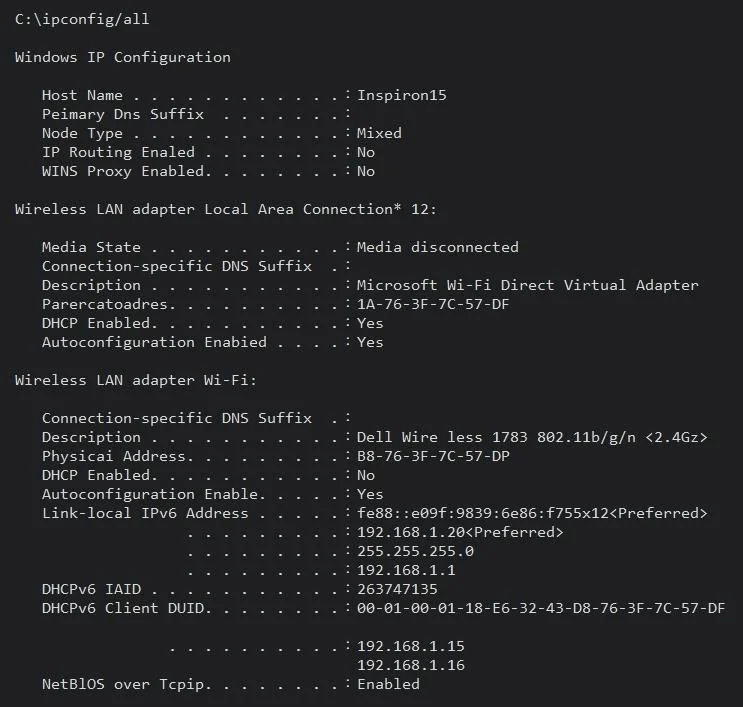
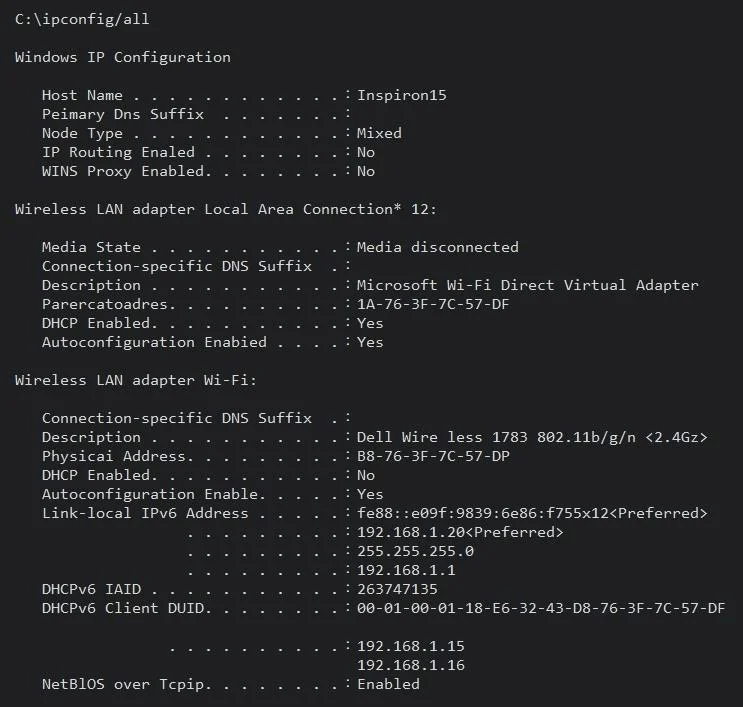
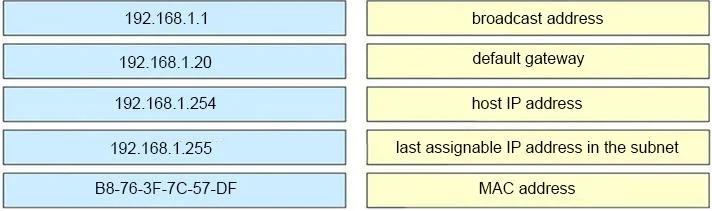
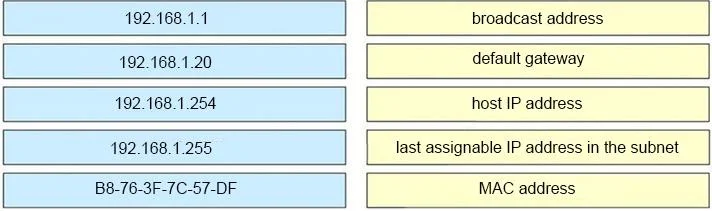
Drag and Drop Question Refer to the exhibit. An engineer is tasked with verifying network configuration parameters on a client workstation to report back to the team lead. Drag and drop the node…
In a typical workstation network configuration, each identifier serves a specific role: the MAC address (B8-76-3F-7C-57-DF) identifies the physical NIC, the host IP (192.168.1.20) is assigned to the workstation itself, the default gateway (192.168.1.254) routes traffic outside…
Question
Exhibits
Answer Area
Drag items
Explanation
In a typical workstation network configuration, each identifier serves a specific role: the MAC address (B8-76-3F-7C-57-DF) identifies the physical NIC, the host IP (192.168.1.20) is assigned to the workstation itself, the default gateway (192.168.1.254) routes traffic outside the subnet, the network address (192.168.1.0 implied) identifies the subnet, and the broadcast address (192.168.1.255) is used to reach all hosts on the /24 subnet. The IP ending in .1 (192.168.1.1) typically represents a DNS server or secondary gateway, while .254 commonly serves as the default gateway in many network configurations. Without the exhibit, these assignments follow standard conventions where the highest usable address (.254) is the gateway, .255 is broadcast, .20 is the host, .1 is the DNS/server, and the MAC address maps to the physical interface identifier.
Topics
Community Discussion
No community discussion yet for this question.