
200-301 · Question #175
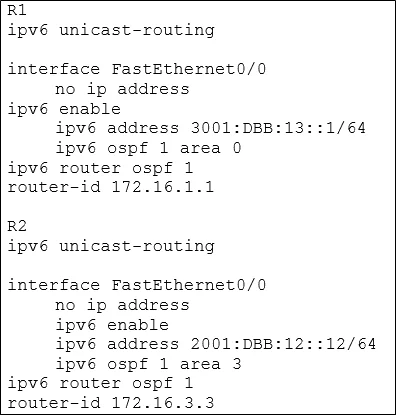
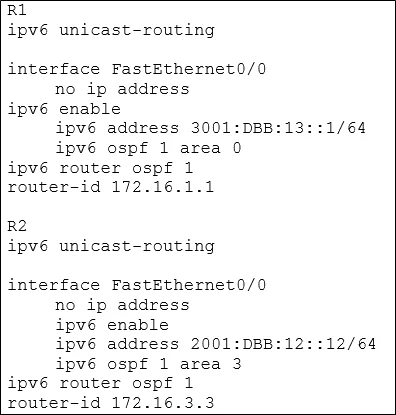
Refer to the exhibit. After you apply the given configurations to R1 and R2 you notice that OSPFv3 fails to start. Which reason for the problem is most likely true ?
The correct answer is A. The area numbers on R1 and R2 are mismatched. For OSPFv3 neighbors to establish an adjacency, they must be configured within the same OSPF area on directly connected links.
Question
Refer to the exhibit. After you apply the given configurations to R1 and R2 you notice that OSPFv3 fails to start. Which reason for the problem is most likely true ?
Exhibits
Options
- AThe area numbers on R1 and R2 are mismatched
- BThe IPv6 network addresses on R1 and R2 are mismatched
- CThe autonomous system numbers on R1 and R2 are mismatched
- DThe router ids on R1 and R2 are mismatched
How the community answered
(70 responses)- A64% (45)
- B9% (6)
- C21% (15)
- D6% (4)
Why each option
For OSPFv3 neighbors to establish an adjacency, they must be configured within the same OSPF area on directly connected links.
For OSPFv3 neighbors to establish an adjacency and for the routing process to start, the connected interfaces must be configured in the same OSPF area. R1 is configured with area 0 for Gig0/0, while R2 is configured with area 1 for Gig0/0, causing an area mismatch.
The IPv6 network addresses (2001:DB8:C:1::/64) on R1 (2001:DB8:C:1::1) and R2 (2001:DB8:C:1::2) are on the same subnet and correctly configured for connectivity.
OSPFv3 does not use autonomous system numbers for neighbor adjacency; it uses a process ID, but that does not need to match between neighbors to form an adjacency.
While router IDs must be unique within an OSPF domain, they do not need to match between neighbors, and a mismatch wouldn't prevent the OSPFv3 process from starting or neighbors from attempting to form. They are used for identifying the originating router of LSAs.
Concept tested: OSPFv3 neighbor adjacency requirements (area mismatch)
Source: https://www.cisco.com/c/en/us/td/docs/ios-xml/ios/iproute_ospf/configuration/15-mt/iro-ospf-15-mt-book/iro-cfg-ospfv3.html#GUID-E1E74987-1A80-4D56-8224-8D2A1EDCE455
Topics
Community Discussion
No community discussion yet for this question.