
200-301 · Question #1686
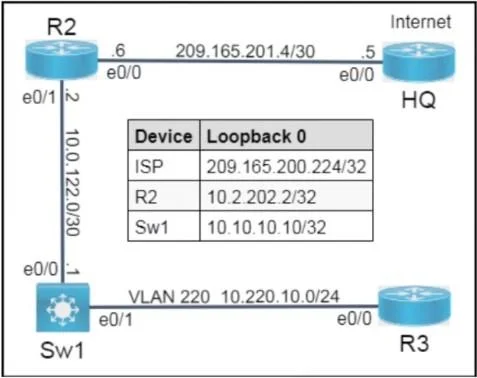
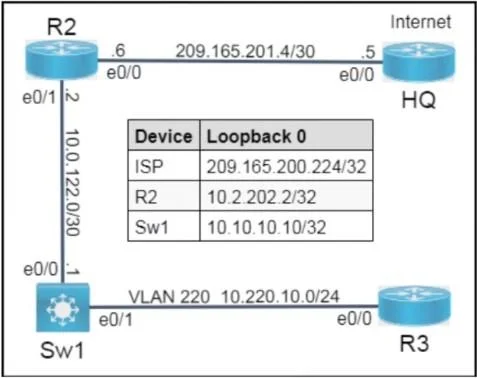
Lab Simulation 55 Please use the "Tasks" and "Topology" tabs to complete this lablet. Topology Tasks Connectivity between the devices has been established. IP services must be configured to complete…
This simulation requires configuring multiple IP services on Router R2: defining NAT inside/outside interfaces (e0/1 as inside facing the private network and e0/0 as outside facing the public network), setting R2 as an authoritative NTP master with 'ntp master 3' (which uses…
Question
Exhibits
Explanation
This simulation requires configuring multiple IP services on Router R2: defining NAT inside/outside interfaces (e0/1 as inside facing the private network and e0/0 as outside facing the public network), setting R2 as an authoritative NTP master with 'ntp master 3' (which uses R2's own clock without relying on external sources or broadcast/multicast), completing DHCP by configuring an IP helper-address on Sw1's VLAN 220 interface pointing to R2, adding an exclusion range for 10.220.10.225-10.220.10.255, and removing SSH version 2 and SSH access-class configurations from R2. The steps outlined in the correct answer align precisely with Cisco IOS commands that satisfy each task's requirements - 'ntp master 3' is the correct command to make a router its own NTP time source at a specified stratum without using broadcast/multicast client modes or peering.
Topics
Community Discussion
No community discussion yet for this question.