
200-301 · Question #1647
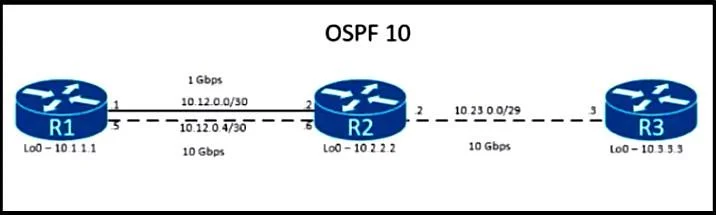
Refer to the exhibit. The loopback IP of R3 has been learned via the two interfaces on R1. R1 is configured with a reference bandwidth of 10 Gbps. Based on the metric calculations, which next hop IP…
The correct answer is C. 10.12.0.6. With R1’s reference bandwidth set to 10 Gbps, the bottom link’s cost is 10 000 Mbps / 10 000 Mbps = 1, whereas the top link’s cost is 10 000 / 1 000 = 10. So the total cost to R3 via the bottom path is 1 (R1→R2) + 1 (R2→R3) = 2, versus 10 + 1 = 11 via the top link. R1 therefore…
Question
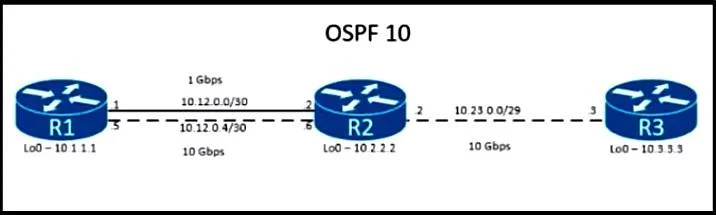
Refer to the exhibit. The loopback IP of R3 has been learned via the two interfaces on R1. R1 is configured with a reference bandwidth of 10 Gbps. Based on the metric calculations, which next hop IP would be used for outgoing routing?
Exhibits
Options
- A10.12.0.2
- B10.12.0.1
- C10.12.0.6
- D10.12.0.5
How the community answered
(21 responses)- A10% (2)
- C86% (18)
- D5% (1)
Explanation
With R1’s reference bandwidth set to 10 Gbps, the bottom link’s cost is 10 000 Mbps / 10 000 Mbps = 1, whereas the top link’s cost is 10 000 / 1 000 = 10. So the total cost to R3 via the bottom path is 1 (R1→R2) + 1 (R2→R3) = 2, versus 10 + 1 = 11 via the top link. R1 therefore uses the bottom-link neighbor, 10.12.0.6.
Topics
Community Discussion
No community discussion yet for this question.