
200-301 · Question #164
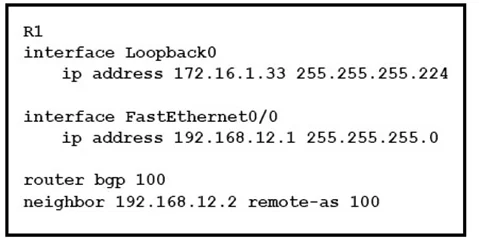
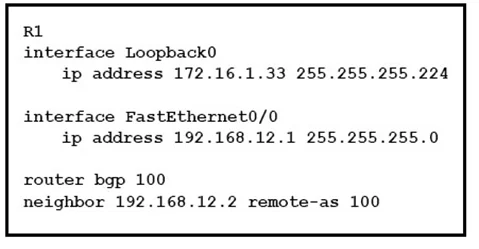
Refer to the exhibit. Which Command do you enter so that R1 advertises the loopback0 interface to the BGP Peers?
The correct answer is A. Network 172.16.1.32 mask 255.255.255.224. First please notice that unlike other routing protocols like OSPF or EIGRP, we have to use subnet mask, not wildcard mask, to advertise the routes in the “network” command -> C is not correct. Secondly, with BGP, you must advertise the correct network and subnet mask in the…
Question
Exhibits
Options
- ANetwork 172.16.1.32 mask 255.255.255.224
- BNetwork 172.16.1.0 0.0.0.255
- CNetwork 172.16.1.32 255.255.255.224
- DNetwork 172.16.1.33 mask 255.255.255.224
- ENetwork 172.16.1.32 mask 0.0.0.31
- FNetwork 172.16.1.32 0.0.0.31
How the community answered
(28 responses)- A82% (23)
- B11% (3)
- C4% (1)
- F4% (1)
Explanation
First please notice that unlike other routing protocols like OSPF or EIGRP, we have to use subnet mask, not wildcard mask, to advertise the routes in the “network” command -> C is not correct. Secondly, with BGP, you must advertise the correct network and subnet mask in the “network” command ( in this case network 172.16.1.32/27). BGP is very strict in the routing advertisements. In other words, BGP only advertises the network which exists exactly in the routing table (in this case network x.x.x.32/27 exists in the routing table as the Fa0/0 interface). If you put the command “network x.x.0.0 mask 255.255.0.0” or “network x.0.0.0 mask 255.0.0.0” or “network x.x.x.33 mask 255.255.255.255” then BGP will not advertise anything. Therefore the full command in this question is “network 172.16.1.32 mask 255.255.255.224”.
Topics
Community Discussion
No community discussion yet for this question.