
200-301 · Question #16
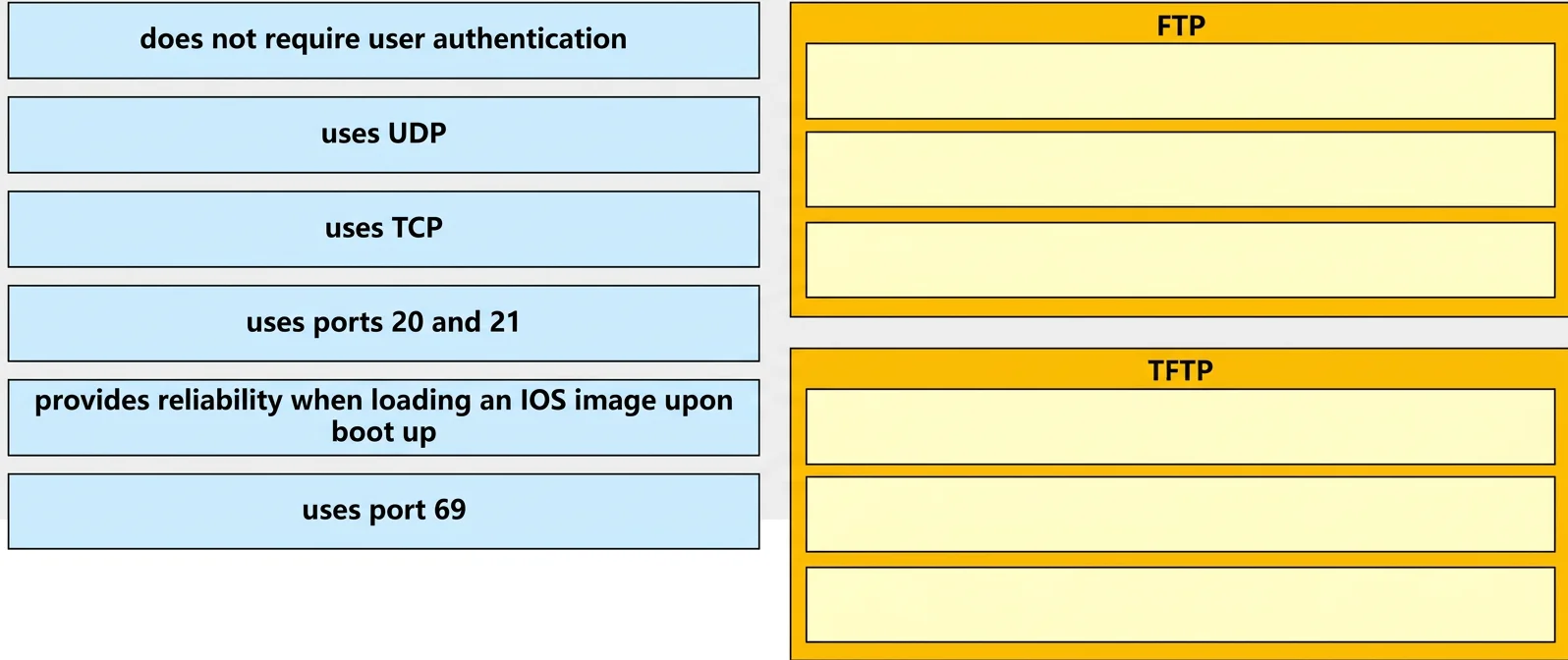
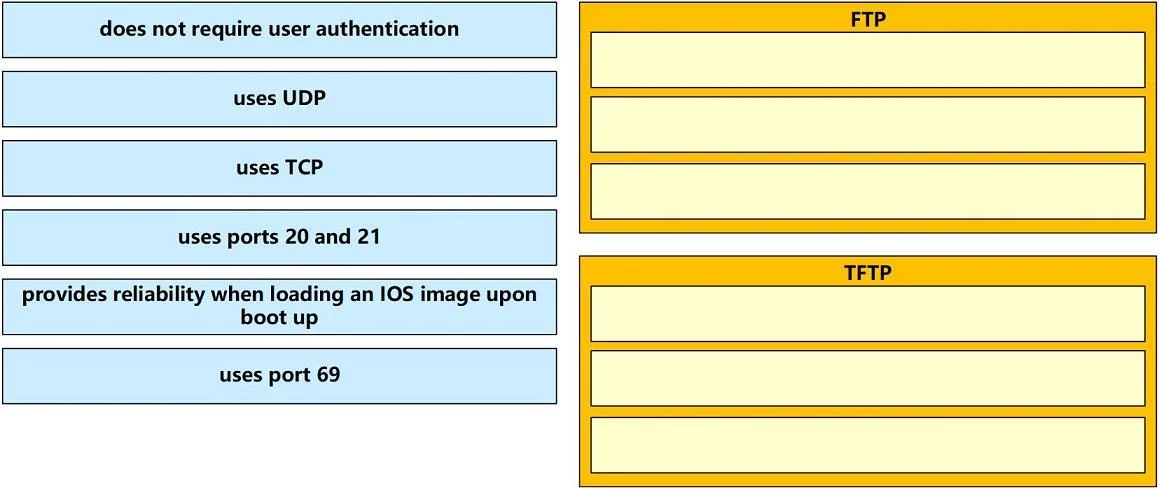
Drag and Drop Question Drag and drop the descriptions of file-transfer protocols from the left onto the correct protocols on the right. Answer:
The correct answer is uses TCP; uses ports 20 and 21; provides reliability when loading an IOS image upon boot up; does not require user authentication; uses UDP; uses port 69. This question maps characteristics to FTP and TFTP. FTP (File Transfer Protocol) uses TCP for reliable, connection-oriented transfers, operates on ports 20 (data) and 21 (control), and provides reliability when loading an IOS image in normal operation. TFTP (Trivial File…
Question
Exhibits
Answer Area
Drag items
Correct arrangement
- uses TCP
- uses ports 20 and 21
- provides reliability when loading an IOS image upon boot up
- does not require user authentication
- uses UDP
- uses port 69
Explanation
This question maps characteristics to FTP and TFTP. FTP (File Transfer Protocol) uses TCP for reliable, connection-oriented transfers, operates on ports 20 (data) and 21 (control), and provides reliability when loading an IOS image in normal operation. TFTP (Trivial File Transfer Protocol) requires no user authentication, uses UDP (connectionless/lightweight), and operates on port 69 - making it ideal for simple, fast transfers like booting a Cisco IOS image from a TFTP server when FTP is unavailable.
Topics
Community Discussion
No community discussion yet for this question.