
200-301 · Question #15
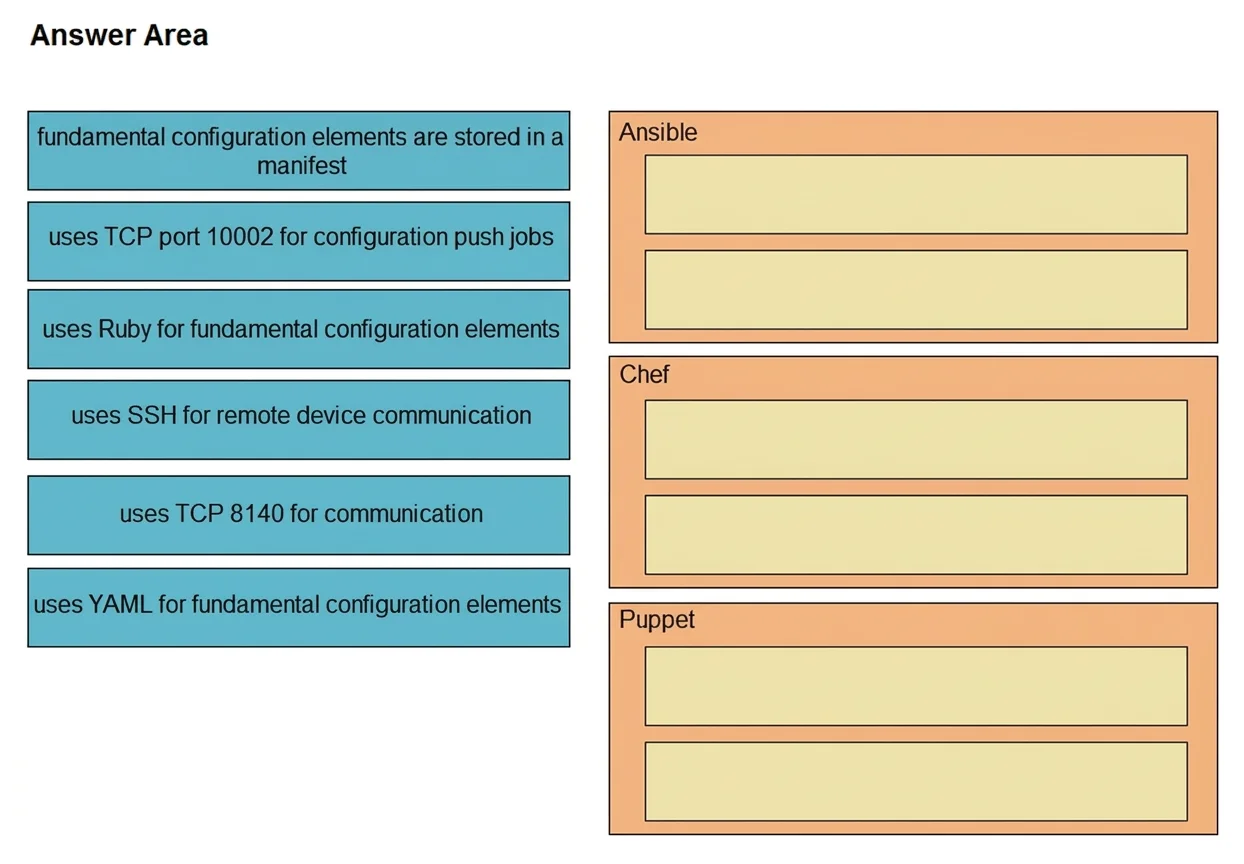
Drag and Drop Question Drag drop the descriptions from the left on to the correct configuration-management technologies on the right. Answer:
The correct answer is uses SSH for remote device communication; uses YAML for fundamental configuration elements; uses TCP port 10002 for configuration push jobs; uses Ruby for fundamental configuration elements; fundamental configuration elements are stored in a manifest; uses TCP 8140 for communication. Configuration Management Technologies - Drag & Drop Explained The question maps 6 descriptions to 3 tools: Ansible, Chef, and Puppet (2 items each). Here's the breakdown: --- Ansible (Items 1 & 2) | Item | Reason | |------|--------| | uses SSH for remote device communication |…
Question
Exhibit
Answer Area
Drag items
Correct arrangement
- uses SSH for remote device communication
- uses YAML for fundamental configuration elements
- uses TCP port 10002 for configuration push jobs
- uses Ruby for fundamental configuration elements
- fundamental configuration elements are stored in a manifest
- uses TCP 8140 for communication
Explanation
Configuration Management Technologies - Drag & Drop Explained
The question maps 6 descriptions to 3 tools: Ansible, Chef, and Puppet (2 items each). Here's the breakdown:
Ansible (Items 1 & 2)
| Item | Reason |
|---|---|
| uses SSH for remote device communication | Ansible is agentless - it connects directly to managed nodes over SSH (no daemon required). This is its defining characteristic. |
| uses YAML for fundamental configuration elements | Ansible playbooks are written in YAML. YAML is the core language for tasks, roles, and inventory. |
Common mistake: Confusing Ansible's YAML with Puppet's DSL - Puppet has its own language, not YAML.
Chef (Items 3 & 4)
| Item | Reason |
|---|---|
| uses TCP port 10002 for configuration push jobs | Chef Push Jobs (the feature that pushes jobs to nodes) uses TCP 10002. This is a specific, testable port number. |
| uses Ruby for fundamental configuration elements | Chef recipes and cookbooks are written in a Ruby-based DSL. Ruby is the native language of the Chef ecosystem. |
Common mistake: Mixing up Chef's Ruby with Puppet - Puppet also has Ruby roots, but its configuration files (manifests) use Puppet's own declarative DSL, not raw Ruby.
Puppet (Items 5 & 6)
| Item | Reason |
|---|---|
| fundamental configuration elements are stored in a manifest | Puppet's core config files are called manifests (.pp files). This is Puppet-specific terminology. |
| uses TCP 8140 for communication | Puppet agents communicate with the Puppet master server over TCP port 8140 by default. |
Common mistake: Students often forget that Puppet uses a client-server (agent-based) model requiring a dedicated port, unlike Ansible's agentless SSH approach.
Quick Reference Summary
| Tool | Language | Protocol/Port |
|---|---|---|
| Ansible | YAML | SSH |
| Chef | Ruby | TCP 10002 (push jobs) |
| Puppet | Manifest (Puppet DSL) | TCP 8140 |
The key to answering this correctly is memorizing each tool's unique identifier: YAML->Ansible, Ruby->Chef, Manifest->Puppet, and their respective ports.
Topics
Community Discussion
No community discussion yet for this question.