
200-301 · Question #1572
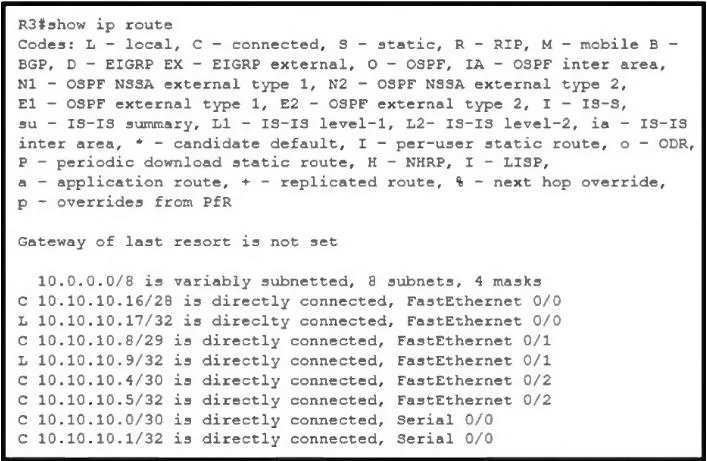
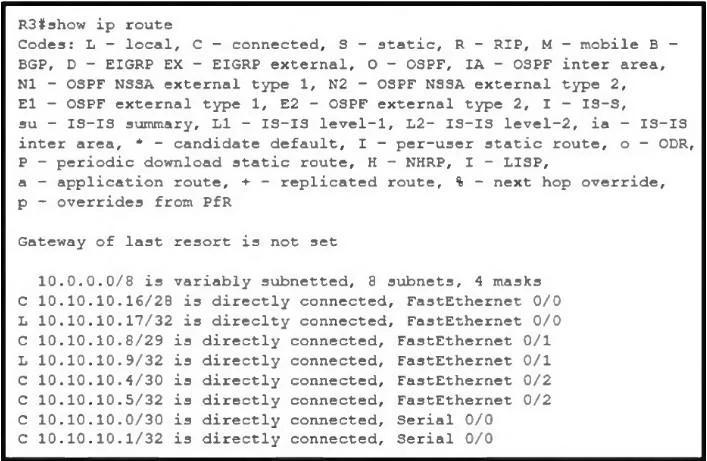
Refer to the exhibit. Which interface does a packet take to reach the destination address of 10.10.10.6?
The correct answer is D. FastEthernet 0/2. To reach the destination 10.10.10.6, a packet takes the FastEthernet 0/2 interface, as indicated by the most specific matching entry in the routing table (from the exhibit, not provided).
Question
Exhibits
Options
- AFastEthernet 0/0
- BSerial 0/0
- CFastEthernet 0/1
- DFastEthernet 0/2
How the community answered
(40 responses)- A15% (6)
- B5% (2)
- C3% (1)
- D78% (31)
Why each option
To reach the destination 10.10.10.6, a packet takes the FastEthernet 0/2 interface, as indicated by the most specific matching entry in the routing table (from the exhibit, not provided).
FastEthernet 0/0 would only be selected if 10.10.10.6 falls within a subnet reachable via this interface, and it is the most specific route available in the routing table.
Serial 0/0 would only be selected if 10.10.10.6 falls within a subnet reachable via this interface, and it is the most specific route available in the routing table.
FastEthernet 0/1 would only be selected if 10.10.10.6 falls within a subnet reachable via this interface, and it is the most specific route available in the routing table.
Based on a standard IP routing table lookup, the destination address 10.10.10.6 would match a specific route pointing to the FastEthernet 0/2 interface as the outgoing path.
Concept tested: IP routing table lookup
Source: https://www.cisco.com/c/en/us/td/docs/ios/iproute/configuration/guide/irg_book/irc_ip_routing_cfg.html
Topics
Community Discussion
No community discussion yet for this question.