
200-301 · Question #154
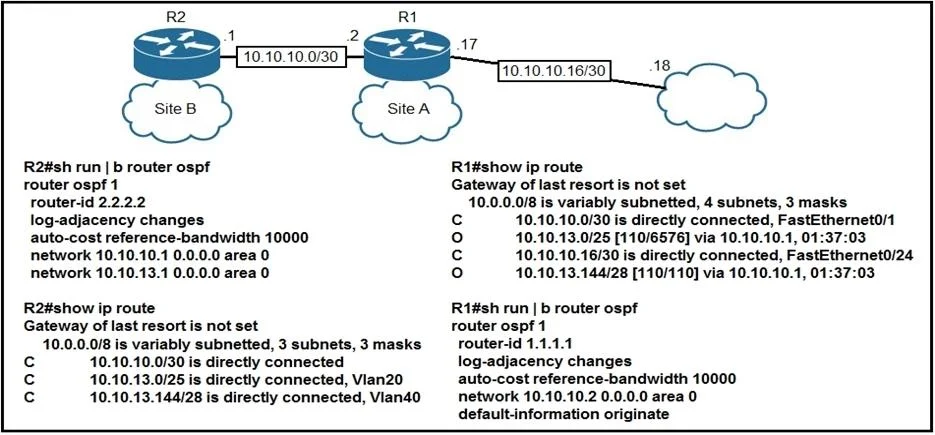
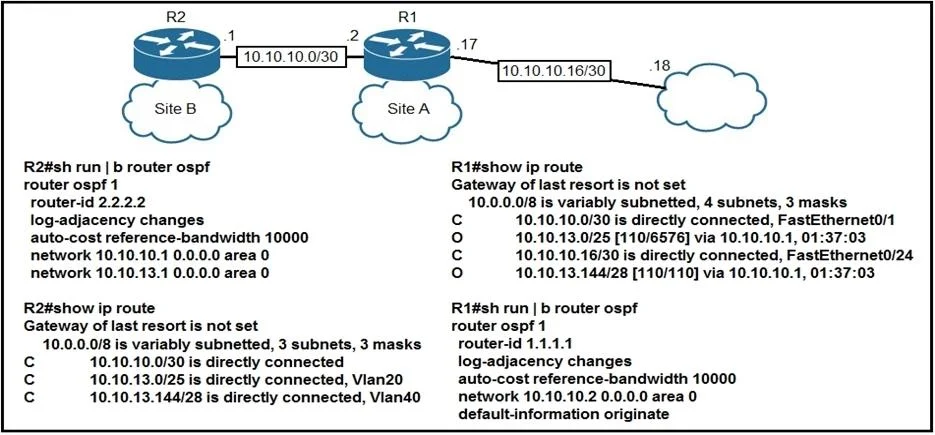
Refer to the exhibit. The default-information originate command is configured under the R1 OSPF configuration. After testing, workstations on VLAN 20 at Site B cannot reach a DNS server on the…
The correct answer is C. Configure the ip route 0.0.0.0 0.0.0.0 10.10.10.18 command on R1. For default-information originate to propagate a default route into OSPF, the originating router (R1) must have a default route (0.0.0.0/0) in its own routing table.
Question
Refer to the exhibit. The default-information originate command is configured under the R1 OSPF configuration. After testing, workstations on VLAN 20 at Site B cannot reach a DNS server on the Internet. Which action corrects the configuration issue?
Exhibits
Options
- AAdd the default-information originate command on R2.
- BAdd the always keyword to the default-information originate command on R1.
- CConfigure the ip route 0.0.0.0 0.0.0.0 10.10.10.18 command on R1.
- DConfigure the ip route 0.0.0.0 0.0.0.0 10.10.10.2 command on R2.
How the community answered
(32 responses)- A25% (8)
- B13% (4)
- C56% (18)
- D6% (2)
Why each option
For `default-information originate` to propagate a default route into OSPF, the originating router (R1) must have a default route (0.0.0.0/0) in its own routing table.
R2 is an internal router in the OSPF domain and does not directly connect to the Internet; adding `default-information originate` on R2 would not resolve the issue of R1 not having a default route to redistribute.
Adding the `always` keyword would force R1 to advertise a default route even if it doesn't have one, which would result in blackholing traffic because R1 wouldn't know how to reach the Internet itself.
The `default-information originate` command requires the router (R1) to have a default route in its own routing table to redistribute it into OSPF. Configuring `ip route 0.0.0.0 0.0.0.0 10.10.10.18` on R1 provides this necessary default route, pointing towards the Internet via the next-hop 10.10.10.18.
Configuring a default route on R2 pointing to 10.10.10.2 (R1) is unnecessary for R2 to learn a default route from R1 via OSPF, and it doesn't solve R1's inability to originate the default route.
Concept tested: OSPF default route origination prerequisites
Source: https://www.cisco.com/c/en/us/td/docs/ios-xml/ios/iproute_ospf/configuration/15-mt/iro-ospf-15-mt-book/iro-cfg-ospfv3.html#GUID-AE971165-42CE-4015-81E9-02688A6E2436
Topics
Community Discussion
No community discussion yet for this question.