
200-301 · Question #1512
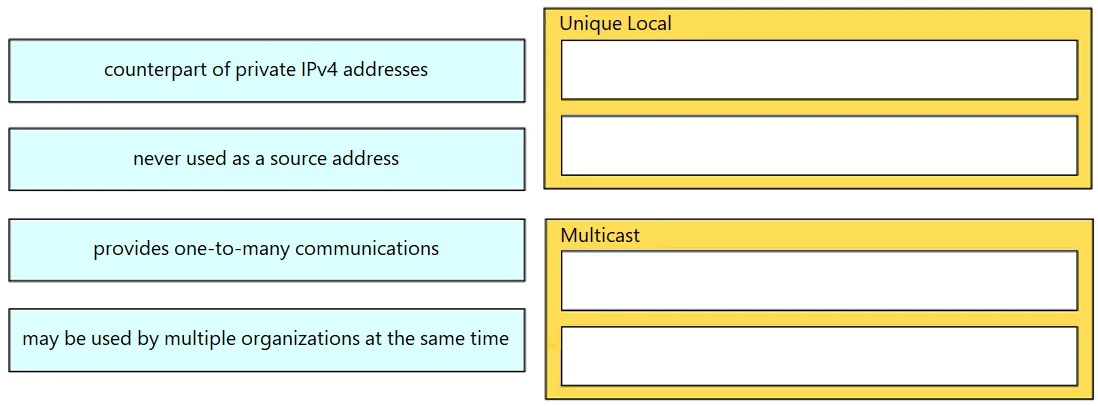
Drag and Drop Question Drag and drop the characteristic from the left onto the IPv6 address type on the right. Answer:
The correct answer is Unique Local: counterpart of private IPv4 addresses; Unique Local: may be used by multiple organizations at the same time; Multicast: never used as a source address; Multicast: provides one-to-many communications. Unique Local addresses (FC00::/7) are the IPv6 counterpart of private IPv4 addresses (like 10.0.0.0/8, 172.16.0.0/12, 192.168.0.0/16) and are not globally routable, but because they are locally assigned without a central registry, multiple organizations can independently use…
Question
Exhibit
Answer Area
Drag items
Correct arrangement
- Unique Local: counterpart of private IPv4 addresses
- Unique Local: may be used by multiple organizations at the same time
- Multicast: never used as a source address
- Multicast: provides one-to-many communications
Explanation
Unique Local addresses (FC00::/7) are the IPv6 counterpart of private IPv4 addresses (like 10.0.0.0/8, 172.16.0.0/12, 192.168.0.0/16) and are not globally routable, but because they are locally assigned without a central registry, multiple organizations can independently use the same unique local address ranges simultaneously. Multicast addresses (FF00::/8) enable one-to-many communications by sending a single packet to multiple receivers who have joined the multicast group, and they are never used as a source address - only as destination addresses, because a source must be a specific unicast interface.
Topics
Community Discussion
No community discussion yet for this question.