
200-301 · Question #1511
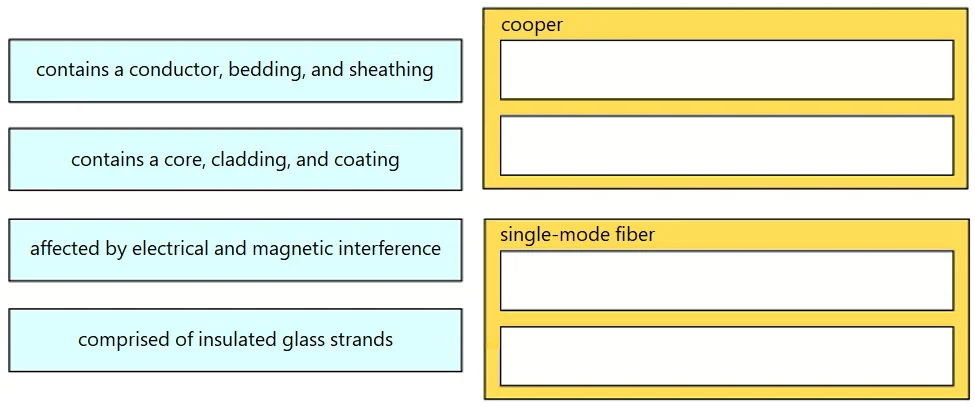
Drag and Drop Question Drag and drop the characteristic from the left onto the cable type on the right. Answer:
This drag-and-drop question matches cable characteristics to their respective cable types: copper/coaxial cables contain a conductor, bedding, and sheathing and are affected by electrical and magnetic interference (EMI), while fiber optic cables contain a core, cladding, and…
Question
Drag and Drop Question Drag and drop the characteristic from the left onto the cable type on the right. Answer:
Exhibit
Answer Area
Drag items
Explanation
This drag-and-drop question matches cable characteristics to their respective cable types: copper/coaxial cables contain a conductor, bedding, and sheathing and are affected by electrical and magnetic interference (EMI), while fiber optic cables contain a core, cladding, and coating and are comprised of insulated glass strands. Copper-based cables are susceptible to EMI because they transmit electrical signals, whereas fiber optic cables use light pulses through glass strands and are immune to EMI. The physical construction of each cable type is a fundamental distinguishing characteristic in networking.
Topics
Community Discussion
No community discussion yet for this question.