
200-301 · Question #1297
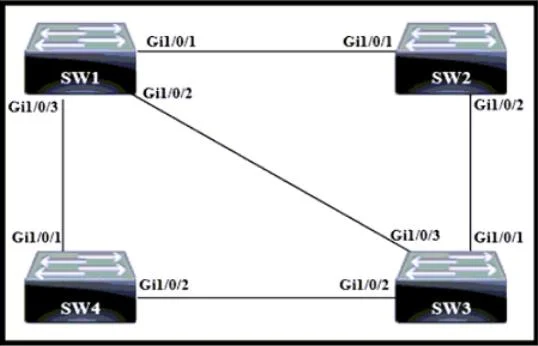
Refer to the exhibit. Which switch becomes the root bridge?
The correct answer is D. SW4. In a Spanning Tree Protocol (STP) enabled network, the root bridge is elected based on the lowest Bridge ID (BID), which comprises the bridge priority and the MAC address. Assuming all priorities are default, the switch with the numerically lowest MAC address will become the…
Question
Exhibits
Options
- ASW3
- BSW2
- CSW1
- DSW4
How the community answered
(22 responses)- A5% (1)
- B5% (1)
- C14% (3)
- D77% (17)
Why each option
In a Spanning Tree Protocol (STP) enabled network, the root bridge is elected based on the lowest Bridge ID (BID), which comprises the bridge priority and the MAC address. Assuming all priorities are default, the switch with the numerically lowest MAC address will become the root bridge.
SW3 would only be the root if it had the lowest BID, which is not the case given SW4 is the correct answer.
SW2 would only be the root if it had the lowest BID, which is not the case given SW4 is the correct answer.
SW1 would only be the root if it had the lowest BID, which is not the case given SW4 is the correct answer.
The root bridge in a Spanning Tree Protocol (STP) domain is the switch with the lowest Bridge ID (BID). The BID is composed of the bridge priority (default 32768) and the switch's base MAC address. If the exhibit showed that SW4 has a lower bridge priority configured than the other switches, or if all priorities are default and SW4 possesses the lowest MAC address among all switches, then SW4 would be elected as the root bridge.
Concept tested: STP root bridge election
Source: https://www.cisco.com/c/en/us/support/docs/lan-switching/spanning-tree-protocol/10556-16.html
Topics
Community Discussion
No community discussion yet for this question.