
200-301 · Question #112
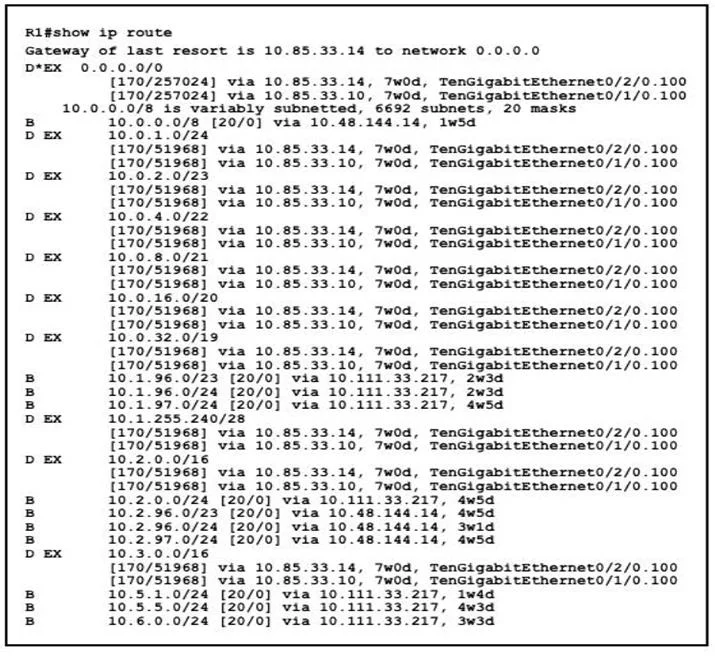
Refer to the exhibit. Which two statements about the network environment of router R1 must be true? (Choose two.)
The correct answer is B. There are 20 different network masks within the 10.0.0.0/8 network. C. Ten routes are equally load-balanced between Te0/1/0.100 and Te0/2/0.100. The network environment of R1 must include variable-length subnet masks within the 10.0.0.0/8 network and employ equal-cost load balancing across two specific subinterfaces for ten EIGRP routes.
Question
Refer to the exhibit. Which two statements about the network environment of router R1 must be true? (Choose two.)
Exhibits
Options
- AThe EIGRP administrative distance was manually changed from 90 to 170.
- BThere are 20 different network masks within the 10.0.0.0/8 network.
- CTen routes are equally load-balanced between Te0/1/0.100 and Te0/2/0.100
- DThe 10.0.0.0/8 network was learned via external EIGRP.
- EA static default route to 10.85.33.14 was defined.
How the community answered
(21 responses)- A24% (5)
- B62% (13)
- D10% (2)
- E5% (1)
Why each option
The network environment of R1 must include variable-length subnet masks within the 10.0.0.0/8 network and employ equal-cost load balancing across two specific subinterfaces for ten EIGRP routes.
The default EIGRP administrative distance for internal routes is 90; 170 is the default for external EIGRP routes, so assuming it was manually changed without further context is not necessarily true.
If the router has learned 20 different network masks within the 10.0.0.0/8 network, it indicates the use of Variable Length Subnet Masking (VLSM) or extensive subnetting, where the router is aware of diverse subnet sizes within that major network.
Equal-cost load balancing suggests that ten EIGRP routes to a particular destination have identical metrics, allowing traffic to be distributed across both Te0/1/0.100 and Te0/2/0.100 interfaces to fully utilize available bandwidth.
While 170 is the AD for external EIGRP, the statement suggests a single network, whereas other options point to more specific and complex routing details likely present in the exhibit.
A static default route is typically configured manually and would be indicated by 'S*' in the routing table, which is unrelated to EIGRP route learning.
Concept tested: EIGRP routing table interpretation, VLSM, equal-cost load balancing
Source: https://www.cisco.com/c/en/us/td/docs/ios/iproute_eigrp/configuration/guide/ire_ps10567_egrp_cg.html
Topics
Community Discussion
No community discussion yet for this question.