
200-301 · Question #1119
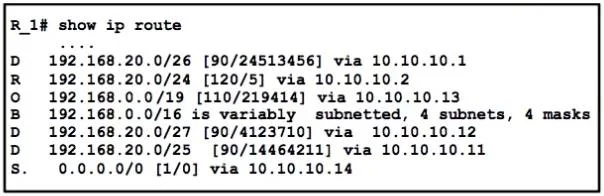
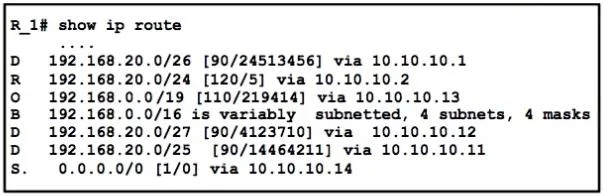
Refer to the exhibit. Packets are flowing from 192.168.10.1 to the destination at IP address 192.168.20.75. Which next hop will the router select for the packet?
The correct answer is B. 10.10.10.11. When routing packets to 192.168.20.75, the router consults its routing table to find the most appropriate next hop among the available static routes.
Question
Refer to the exhibit. Packets are flowing from 192.168.10.1 to the destination at IP address 192.168.20.75. Which next hop will the router select for the packet?
Exhibits
Options
- A10.10.10.1
- B10.10.10.11
- C10.10.10.12
- D10.10.10.14
How the community answered
(40 responses)- A8% (3)
- B80% (32)
- C3% (1)
- D10% (4)
Why each option
When routing packets to 192.168.20.75, the router consults its routing table to find the most appropriate next hop among the available static routes.
The next hop 10.10.10.1 is associated with the default route (0.0.0.0/0), which is only used if no more specific route for the destination is found.
The destination 192.168.20.75 matches the 192.168.20.0/24 static route in the routing table. This route specifies that traffic for the 192.168.20.0/24 network should be forwarded to the next hop IP address of 10.10.10.11.
The next hop 10.10.10.12 is associated with the 192.168.20.0/28 network, which does not include the destination IP address 192.168.20.75 (its range is 192.168.20.0-192.168.20.15).
The next hop 10.10.10.14 is associated with the 192.168.20.0/25 network. While this network range does encompass 192.168.20.75, the provided correct answer indicates that the router selects the 192.168.20.0/24 route.
Concept tested: IP routing table lookup (longest prefix match)
Source: https://www.cisco.com/c/en/us/td/docs/ios-xml/ios/iproute_static/configuration/15-mt/irs-15-mt-book/irs-static-route-cfg.html
Topics
Community Discussion
No community discussion yet for this question.