
200-301 · Question #1111
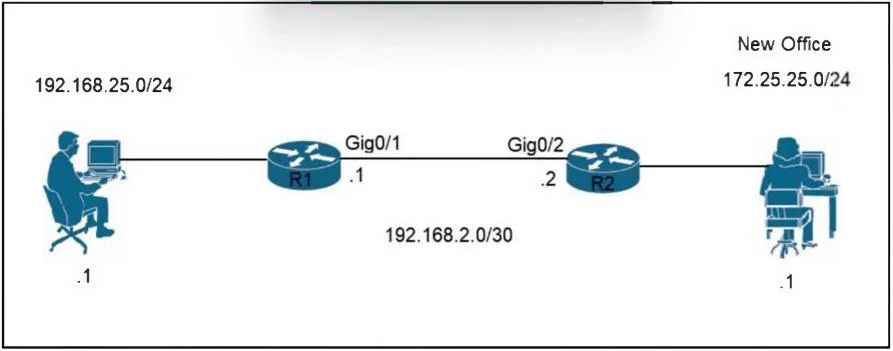
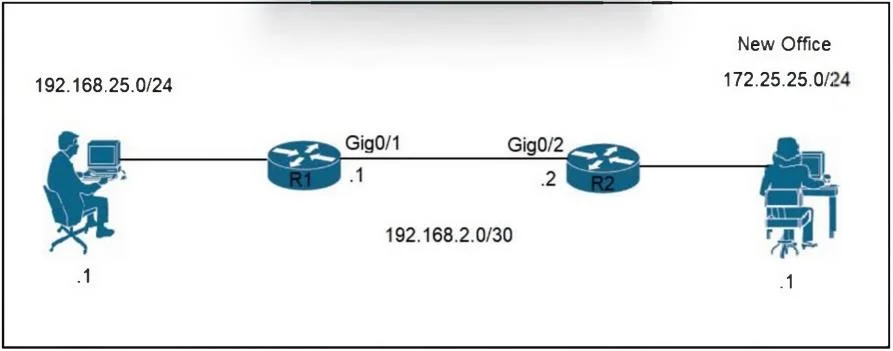
Refer to the exhibit. A network engineer is updating the configuration on router R1 to connect a new branch office to the company network. R2 has been configured correctly. Which command must the…
The correct answer is B. ip route 172.25.25.0 255.255.255.0 192.168.2.2. To allow R1 to communicate with the new branch office network 172.25.25.0/24 behind R2, R1 requires a static route pointing to R2's interface IP as the next hop.
Question
Exhibits
Options
- Aip route 172.25.25.1 255.255.255.255 g0/2
- Bip route 172.25.25.0 255.255.255.0 192.168.2.2
- Cip route 172.25.25.0 255.255.255.0 192.168.2.1
- Dip route 172.25.25.1 255.255.255.255 g0/1
How the community answered
(52 responses)- A17% (9)
- B71% (37)
- C4% (2)
- D8% (4)
Why each option
To allow R1 to communicate with the new branch office network 172.25.25.0/24 behind R2, R1 requires a static route pointing to R2's interface IP as the next hop.
This command defines a host route for a single IP address (172.25.25.1) instead of the entire network, and uses an exit interface (g0/2) instead of a next-hop IP.
The command `ip route 172.25.25.0 255.255.255.0 192.168.2.2` correctly defines a static route on R1 for the entire 172.25.25.0/24 network, specifying R2's G0/1 interface IP (192.168.2.2) as the next hop, enabling R1 to forward traffic to the new site.
This command incorrectly specifies R1's own interface IP (192.168.2.1) as the next-hop, which would create an invalid route on R1 itself.
This command defines a host route for a single IP address (172.25.25.1) and uses an incorrect exit interface (g0/1) for a static route to a remote network.
Concept tested: Configuring static IPv4 routes
Source: https://www.cisco.com/c/en/us/td/docs/ios-xml/ios/iproute_static/configuration/15-mt/irs-15-mt-book/irs-static-route-cfg.html
Topics
Community Discussion
No community discussion yet for this question.