
200-301 · Question #1034
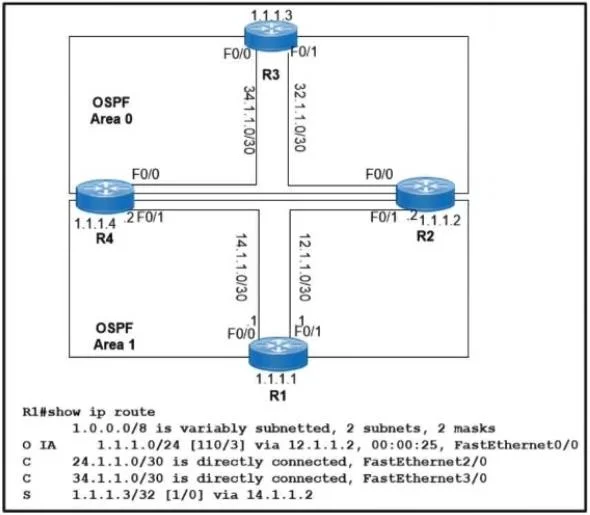
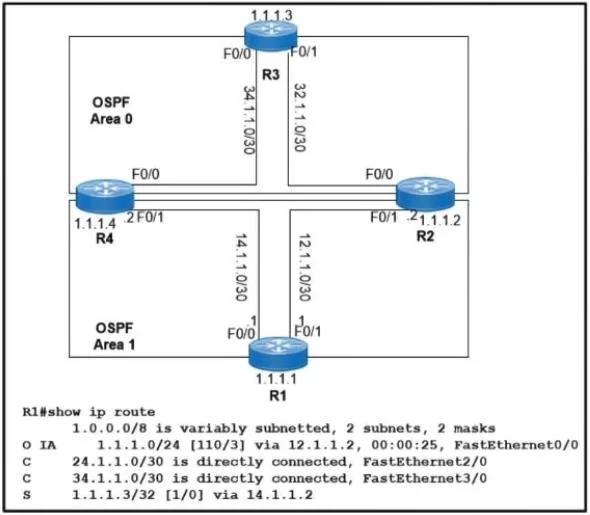
Refer to the exhibit. Which two values does router R1 use to determine the best path to reach destinations in network 1.0.0.0/8? (Choose two.)
The correct answer is A. longest prefix match D. lowest metric. Router R1 uses the longest prefix match to select routes and, for routes with the same prefix length, chooses the one with the lowest metric to determine the best path.
Question
Exhibits
Options
- Alongest prefix match
- Bhighest administrative distance
- Chighest metric
- Dlowest metric
- Elowest cost to reach the next hop
How the community answered
(32 responses)- A75% (24)
- B16% (5)
- C3% (1)
- E6% (2)
Why each option
Router R1 uses the longest prefix match to select routes and, for routes with the same prefix length, chooses the one with the lowest metric to determine the best path.
The routing lookup process always prioritizes the longest prefix match, meaning the most specific route in the routing table (e.g., /32 is preferred over /24) is selected first.
Routers use the *lowest* administrative distance to compare paths learned from different routing protocols, not the highest, to determine preference.
Routers select paths with the *lowest* metric, as a higher metric typically indicates a less desirable or more costly path.
If multiple routes to the same destination (with identical prefix lengths and administrative distances) exist, the router selects the path with the lowest metric, as it represents the most efficient or preferred path according to the routing protocol's calculation.
'Lowest cost to reach the next hop' is a component of some routing metrics, but 'lowest metric' is the broader criterion used by the routing table lookup process for path selection.
Concept tested: Router path selection principles
Source: https://www.cisco.com/c/en/us/support/docs/ip/border-gateway-protocol-bgp/200782-BGP-Best-Path-Selection-Algorithm.html
Topics
Community Discussion
No community discussion yet for this question.