
200-155 · Question #39
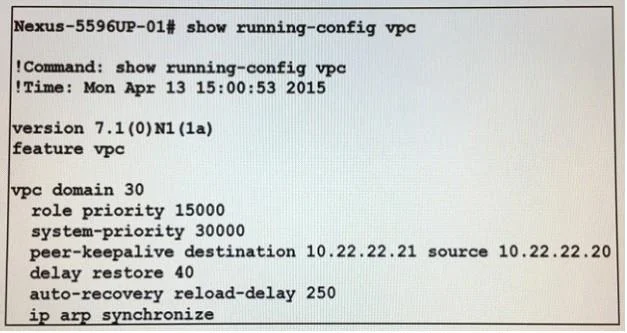
Refer to the exhibit. Which statement is correct regarding this vPC environment?
The correct answer is D. The system priority has been configured to a lower number than its default value. In a Cisco vPC environment, the system priority is a configurable parameter that influences which peer device assumes the primary role.
Question
Refer to the exhibit. Which statement is correct regarding this vPC environment?
Exhibit
Options
- AThe vPC peer keep alive uses a non-VRF path.
- BThe ip arp synchronize is automatically configured when a vPC domain is created.
- CThe rote priority uses its default value.
- DThe system priority has been configured to a lower number than its default value.
How the community answered
(34 responses)- A12% (4)
- B3% (1)
- C3% (1)
- D82% (28)
Why each option
In a Cisco vPC environment, the system priority is a configurable parameter that influences which peer device assumes the primary role.
The vPC peer keepalive link typically uses a dedicated Layer 3 interface and can be configured within a specific VRF instance, so it is not inherently required to use a non-VRF path.
The 'ip arp synchronize' command, which synchronizes ARP entries between vPC peers, is not automatically configured by default when a vPC domain is created and usually requires explicit configuration.
While 'system priority' is a key vPC parameter, 'route priority' is not a standard vPC configuration, and the default system priority is 32678.
The default vPC system priority value is 32678; configuring a numerically lower value (e.g., 1000) makes the device more preferred in the vPC election process, indicating a deliberate change from the default configuration.
Concept tested: Cisco Nexus vPC system priority configuration
Source: https://www.cisco.com/c/en/us/products/collateral/switches/nexus-7000-series-switches/guide_c07-617872.html
Topics
Community Discussion
No community discussion yet for this question.