
200-155 · Question #111
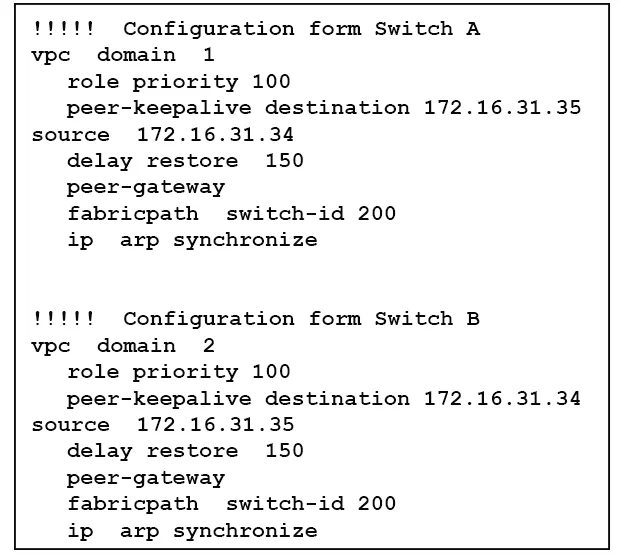
Refer to the exhibit. Which option do you configure to correct the vPC configuration between two peer switches?
The correct answer is C. identical domain IDs. To ensure a correct vPC configuration between two peer switches, it is crucial that both switches have identical domain IDs, as this establishes their membership in the same vPC domain.
Question
Refer to the exhibit. Which option do you configure to correct the vPC configuration between two peer switches?
Exhibit
Options
- Aunique role priority value
- Bunique fabricpath switch-id
- Cidentical domain IDs
- Didentical peer-keepalive IP addresses
How the community answered
(59 responses)- A2% (1)
- B3% (2)
- C95% (56)
Why each option
To ensure a correct vPC configuration between two peer switches, it is crucial that both switches have identical domain IDs, as this establishes their membership in the same vPC domain.
A unique role priority value is used to determine the vPC primary switch, but having a unique value isn't inherently a "correction" for a non-working vPC, as typically one is primary and one is secondary.
FabricPath switch-id is relevant for FabricPath networks and has no direct bearing on correcting a standard Virtual Port-Channel (vPC) configuration.
Identical domain IDs are a fundamental requirement for a correct vPC configuration because the vPC domain ID identifies the pair of Nexus switches as belonging to the same vPC group. Without matching domain IDs, the vPC peering cannot be established correctly.
Identical peer-keepalive IP addresses would prevent the keepalive mechanism from functioning, as each switch needs a distinct IP address on the peer-keepalive link to communicate with its peer.
Concept tested: Cisco Nexus vPC configuration requirements
Source: https://www.cisco.com/c/en/us/td/docs/switches/datacenter/nexus5000/sw/n5k_n7k_ip_services/513_n7k_n5k_ip_services_config/n7k_n5k_vpc.html
Topics
Community Discussion
No community discussion yet for this question.