
1Z0-909 · Question #36
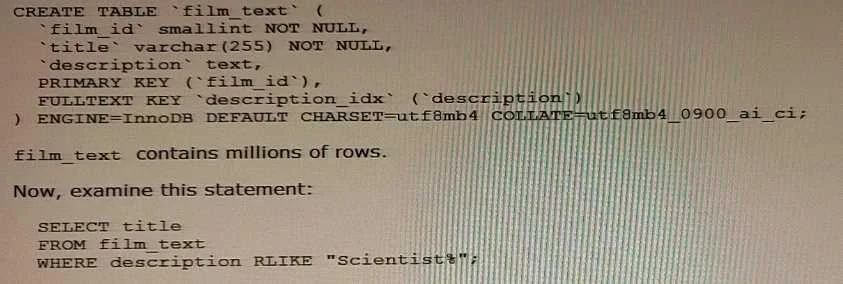
Examine this statement which has executed successfully:
The correct answer is A. Execution performance can be improved by using like instead of RLIKE. Option A is correct because RLIKE (regex matching) cannot use B-tree indexes - the database engine must perform a full table scan to evaluate each row against the regular expression pattern. Switching to LIKE with a leading-literal pattern (e.g., LIKE 'abc%') allows the…
Question
Examine this statement which has executed successfully:
Exhibit
Options
- AExecution performance can be improved by using like instead of RLIKE.
- BThe statement takes advantage of index description_idx.
- CExecution performance can be improved by, using a composite index with column description as
- DNo index will improve statement performance.
- EExecution performance can be improved by adding an index on column description.
How the community answered
(63 responses)- A63% (40)
- B5% (3)
- C19% (12)
- D10% (6)
- E3% (2)
Explanation
Option A is correct because RLIKE (regex matching) cannot use B-tree indexes - the database engine must perform a full table scan to evaluate each row against the regular expression pattern. Switching to LIKE with a leading-literal pattern (e.g., LIKE 'abc%') allows the optimizer to perform an index range scan, dramatically reducing rows examined.
Why the distractors are wrong:
- B is wrong because even though
description_idxexists, RLIKE bypasses it entirely - the index is present but unused. - C is wrong for the same reason: a composite index still can't rescue a regex scan; the bottleneck is the operator, not the index structure.
- D is wrong because it assumes no index can help at all - but an index would help once the operator is changed to LIKE.
- E is wrong because an index on
descriptionlikely already exists (description_idx); adding another won't fix an operator that ignores indexes.
Memory tip: Think of it as "RLIKE = Regex = Row-by-row" - all three start with R. Any operator that requires inspecting the full value of every row (regex, functions like LOWER(), SUBSTRING()) defeats index lookups. LIKE with a leading literal is the index-friendly alternative.
Topics
Community Discussion
No community discussion yet for this question.