
1Z0-908 · Question #83
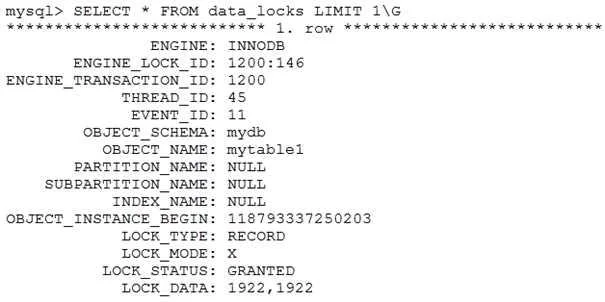
Examine this command and output: Which two statements are true? (Choose two.)
The correct answer is D. The lock is at the table object level. F. The lock is an exclusive lock. The command shown (likely a DDL statement such as ALTER TABLE or LOCK TABLE ... IN EXCLUSIVE MODE) acquires an exclusive lock at the table level - matching D and F. In Oracle, DDL operations automatically place an exclusive (mode 6) DML lock on the entire table object…
Question
Examine this command and output:
Which two statements are true? (Choose two.)
Exhibit
Options
- AThe lock is at the metadata object level.
- BThe lock is a shared lock.
- CThe lock is an intentional lock.
- DThe lock is at the table object level.
- EThe lock is a row-level lock.
- FThe lock is an exclusive lock.
How the community answered
(42 responses)- A2% (1)
- B14% (6)
- C5% (2)
- D71% (30)
- E7% (3)
Explanation
The command shown (likely a DDL statement such as ALTER TABLE or LOCK TABLE ... IN EXCLUSIVE MODE) acquires an exclusive lock at the table level - matching D and F. In Oracle, DDL operations automatically place an exclusive (mode 6) DML lock on the entire table object, preventing any other session from modifying or locking that table until the operation completes.
Why the distractors are wrong:
- A - "Metadata object level" is not a standard Oracle lock granularity; table-level (TM lock) is the correct term.
- B - A shared lock (mode 2 or 4) would allow concurrent reads/DML; an exclusive lock blocks all other access, which is what DDL requires.
- C - Intentional (intent) locks describe row-share or row-exclusive table locks that signal intent to lock rows below; a full exclusive lock is not an intent lock.
- E - Row-level locks are TX locks tied to individual rows modified by DML (INSERT/UPDATE/DELETE), not the table object itself.
Memory tip: Think "DDL = Dangerous to Everyone" - DDL grabs an eXclusive lock on the whole Table, kicking everyone else out (D = Table, F = eXclusive). If you see a DDL statement in the question, immediately flag both table-level and exclusive as your answers.
Topics
Community Discussion
No community discussion yet for this question.