
1Z0-908 · Question #36
Your MySQL server was upgraded from an earlier major version. The sales database contains three tables, one of which is the transactions table, which has 4 million rows. You are running low on disk…
The correct answer is A. Executing SET GLOBAL innodb_row_format=COMPRESSED and then ALTER TABLE E. The transactions table was created with innodb_file_per_table=OFF. Option E is correct because the MySQL server was upgraded from an older major version where innodb_file_per_table defaulted to OFF (prior to MySQL 5.6.7). This means the transactions table's data lives inside the shared system tablespace (ibdata1), which is critical context for…
Question
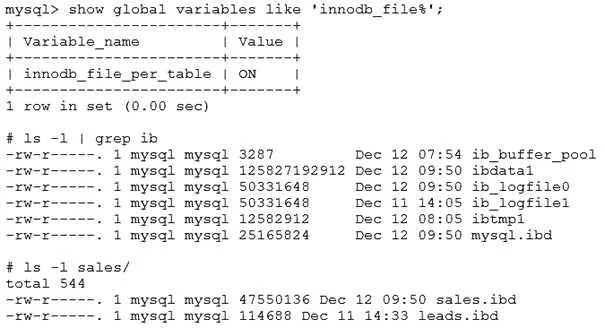
Your MySQL server was upgraded from an earlier major version. The sales database contains three tables, one of which is the transactions table, which has 4 million rows. You are running low on disk space on the datadir partition and begin to investigate. Examine these commands and output:
Which two statements are true? (Choose two.)
Exhibit
Options
- AExecuting SET GLOBAL innodb_row_format=COMPRESSED and then ALTER TABLE
- BExecuting ALTER TABLE transactions will enable you to free up disk space.
- CTruncating the sales and leads table will free up disk space.
- DTruncating the transactions table will free up the most disk space.
- EThe transactions table was created with innodb_file_per_table=OFF.
How the community answered
(30 responses)- A60% (18)
- B20% (6)
- C7% (2)
- D13% (4)
Explanation
Option E is correct because the MySQL server was upgraded from an older major version where innodb_file_per_table defaulted to OFF (prior to MySQL 5.6.7). This means the transactions table's data lives inside the shared system tablespace (ibdata1), which is critical context for every other choice.
Option A is correct because combining SET GLOBAL innodb_row_format=COMPRESSED with ALTER TABLE transactions will rebuild the table using InnoDB page compression and - since innodb_file_per_table now defaults to ON post-upgrade - move it into its own smaller .ibd file, genuinely reducing disk usage on the partition.
Option B is wrong because a plain ALTER TABLE without first enabling compression would simply rebuild the table at roughly the same size; no meaningful disk space is reclaimed this way.
Option C is wrong because the sales and leads tables are presumably small compared to the 4M-row transactions table, and truncating them provides negligible disk savings.
Option D is wrong - this is the key trap: because the transactions table lives in ibdata1 (per option E), TRUNCATE marks space as free inside the shared tablespace file but ibdata1 never shrinks, so no OS-level disk space is recovered.
Memory tip: "ibdata1 is a one-way street - data goes in but disk space never comes back." When innodb_file_per_table=OFF, your only path to reclaiming space is to rebuild with compression into a per-table file using ALTER TABLE.
Topics
Community Discussion
No community discussion yet for this question.