
1Z0-821 · Question #53
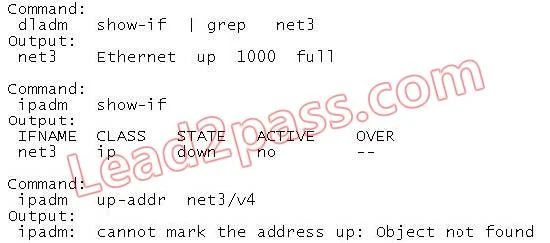
You are troubleshooting interface net3 and you enter the following sequence of commands: Your next command should be:
The correct answer is E. ipadm create-addr -T static -a 192.168.1.25/24 net3. If you are assigning a static IP address, use the following syntax: # ipadm create-addr -T static -a address addrobj where addrobj uses the naming format interface/user-defined-string, such as e1000g0/v4globalz. create-addr [-t] -T static [-d] -a {local |…
Question
You are troubleshooting interface net3 and you enter the following sequence of commands:
Your next command should be:
Exhibit
Options
- Aipadm up-addr net3/v4
- Bipadm enable-if -T net3
- C<ipadm create-vnic -a 192.168.1.25/24 net3/v4
- Dipadm create-ip -T static -a 192.168.1.25/24 -n net3
- Eipadm create-addr -T static -a 192.168.1.25/24 net3
How the community answered
(27 responses)- A4% (1)
- B7% (2)
- C15% (4)
- D4% (1)
- E70% (19)
Explanation
If you are assigning a static IP address, use the following syntax: # ipadm create-addr -T static -a address addrobj where addrobj uses the naming format interface/user-defined-string, such as e1000g0/v4globalz. create-addr [-t] -T static [-d] -a {local | remote}=addr[/prefixlen], ... addrobj Creates a static IPv4 or IPv6 address on the interface specified in addrobj. If the interface on which the address is created is not plumbed, this subcommand will implicitly plumb the interface. The created static address will be identified by addrobj. By default, a configured address will be marked up, so that it can be used as a source or destination of or for outbound and inbound packets.
Topics
Community Discussion
No community discussion yet for this question.