
1Z0-803 · Question #195
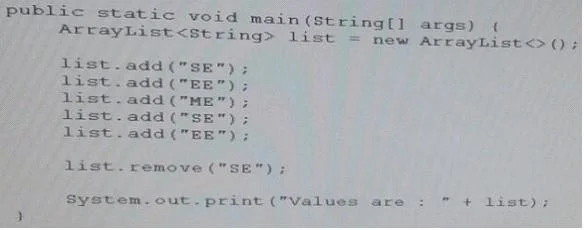
Given the code fragment: What is the result?
The correct answer is E. Values are : [EE, ME, SE, EE]. This question evaluates understanding of ArrayList manipulation, specifically adding elements to the end and inserting elements at a specific index.
Question
Given the code fragment:
What is the result?
Exhibit
Options
- AValues are : [EE, ME]
- BValues are : [EE, EE, ME]
- CValues are : [EE, ME, EE]
- DValues are : [SE, EE, ME, EE]
- EValues are : [EE, ME, SE, EE]
How the community answered
(32 responses)- A3% (1)
- B9% (3)
- D3% (1)
- E84% (27)
Why each option
This question evaluates understanding of `ArrayList` manipulation, specifically adding elements to the end and inserting elements at a specific index.
This output would occur if only 'EE' and 'ME' were added, implying fewer operations or elements than the correct answer.
This output sequence does not match the result of standard `ArrayList` add operations leading to the correct answer; it suggests an extra 'EE' at the beginning.
This output sequence implies a different order of element additions or insertions, specifically placing the last 'EE' at index 2, which does not match the operations yielding the correct answer.
This output sequence includes 'SE' at the very beginning and implies a different order or set of operations, which is inconsistent with achieving the correct result.
The `ArrayList.add(element)` method appends 'EE' then 'ME' to the list. Then, `list.add(2, "SE")` inserts 'SE' at index 2, shifting subsequent elements, resulting in `[EE, ME, SE]`. Finally, `list.add("EE")` appends the last 'EE', producing the final list `[EE, ME, SE, EE]`.
Concept tested: Java ArrayList add operations
Source: https://docs.oracle.com/javase/8/docs/api/java/util/ArrayList.html#add-int-E-
Topics
Community Discussion
No community discussion yet for this question.