nerdexam
Oracle

1Z0-599 · Question #49

A customer needs to implement a Highly Available solution for JMS that has a primary data center and a backup. Which three steps would you perform when designing your solution?

The correct answer is A. Store Transaction Logs in a database and use Database stores for JMS to make replication C. Implement Oracle RAC at each site to provide a highly available solution within each datacenter. E. Configure Automatic Service Migration for JMS high availability within a datacenter. For a two-datacenter JMS HA architecture, you need three layers working together: A uses database-backed JMS stores and transaction logs, which enables native database replication (e.g., Oracle Data Guard) to synchronize message data between the primary and backup sites…

Configuring WebLogic Server Resources

Question

A customer needs to implement a Highly Available solution for JMS that has a primary data center and a backup. Which three steps would you perform when designing your solution?

Exhibit
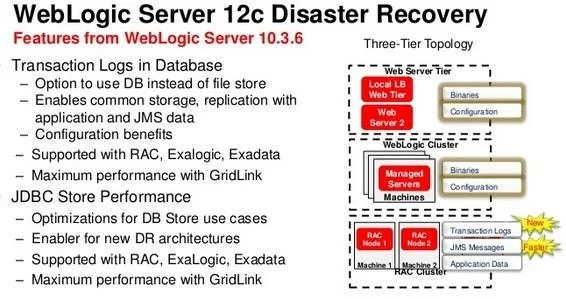
1Z0-599 question #49 exhibit

Options

  • AStore Transaction Logs in a database and use Database stores for JMS to make replication
  • BUse file based Transaction Logs and JMS stores and implement a separate replication solution
  • CImplement Oracle RAC at each site to provide a highly available solution within each datacenter.
  • DConfigure Whole Server Migration to migrate WebLogic Managed Servers from the primary to the
  • EConfigure Automatic Service Migration for JMS high availability within a datacenter.

How the community answered

(35 responses)
  • A
    63% (22)
  • B
    11% (4)
  • D
    26% (9)

Explanation

For a two-datacenter JMS HA architecture, you need three layers working together: A uses database-backed JMS stores and transaction logs, which enables native database replication (e.g., Oracle Data Guard) to synchronize message data between the primary and backup sites - file-based stores lack this built-in replication capability. C deploys Oracle RAC at each site, ensuring no single database node failure can bring down JMS persistence within a datacenter. E configures Automatic Service Migration (ASM), which detects JMS service failures and automatically re-hosts those services on a healthy managed server within the same cluster, providing fine-grained service-level recovery.

B is wrong because file-based stores require you to bolt on a separate, error-prone replication tool - the database approach in A handles this natively and more reliably. D is wrong because Whole Server Migration is a coarser, single-datacenter mechanism that migrates an entire server instance (not just JMS services) and is not designed for cross-datacenter failover; ASM in option E is the preferred, JMS-specific approach.

Memory tip: Think of the three layers as "Store → Survive → Shift" - Store data in a DB (A) so it can replicate across sites, Survive node failures with RAC (C), and Shift JMS services automatically on failure with ASM (E).

Topics

#JMS High Availability#Database Stores#Automatic Service Migration#Oracle RAC

Community Discussion

No community discussion yet for this question.

Full 1Z0-599 Practice