
1Z0-117 · Question #98
Which two types of column filtering may benefit from partition pruning?
The correct answer is A. Equally operates on range-partitioned tables. D. Operators on range-partitioned tables. The query optimizer can perform pruning whenever a WHERE condition can be reduced to either one of the following two cases: partition_column = constant partition_column IN (constant1, constant2, ..., constantN) In the first case, the optimizer simply evaluates the partitioning…
Question
Which two types of column filtering may benefit from partition pruning?
Exhibit
Options
- AEqually operates on range-partitioned tables.
- BIn-list operators on system-partitioned tables
- CEquality operators on system-partitioned tables
- DOperators on range-partitioned tables
- EGreater than operators on hash-partitioned tables
How the community answered
(30 responses)- A73% (22)
- B7% (2)
- C17% (5)
- E3% (1)
Explanation
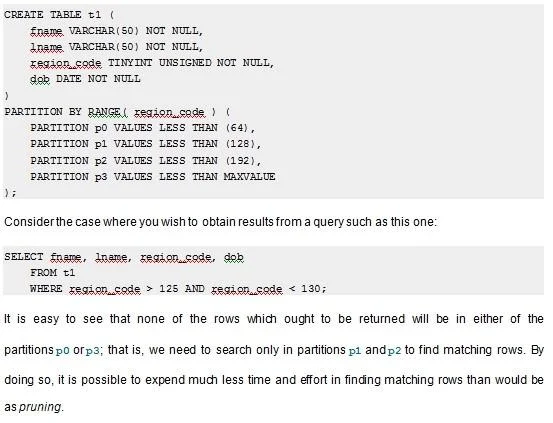
The query optimizer can perform pruning whenever a WHERE condition can be reduced to either one of the following two cases: partition_column = constant partition_column IN (constant1, constant2, ..., constantN) In the first case, the optimizer simply evaluates the partitioning expression for the value given, determines which partition contains that value, and scans only this partition. In many cases, the equal sign can be replaced with another arithmetic comparison, including <, >, <=, >=, and <>. Some queries using BETWEEN in the WHERE clause can also take advantage of partition pruning. * The core concept behind partition pruning is relatively simple, and can be described as "Do not scan partitions where there can be no matching values". When the optimizer can make use of partition pruning in performing a query, execution of the query can be an order of magnitude faster than the same query against a nonpartitioned table containing the same column definitions Suppose that you have a partitioned table t1 defined by this statement:
Topics
Community Discussion
No community discussion yet for this question.