
Oracle
1Z0-117 · Question #63
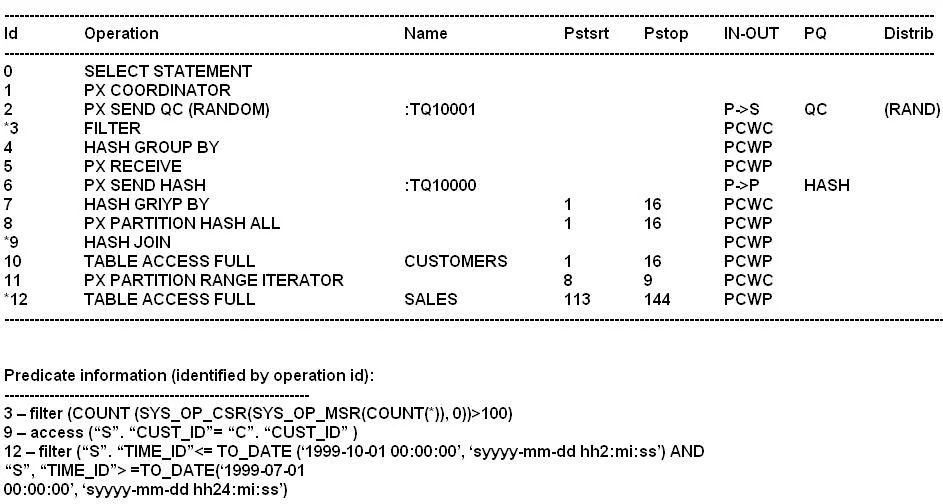
Examine the exhibit. Which two are true concerning the execution plan?
The correct answer is B. A full partition-wise join is used D. The SALES table is composite partitioned. The following example shows the execution plan for the full partition-wise join with the sales table range partitioned by time_id, and subpartitioned by hash on cust_id. 3 - filter(COUNT(SYS_OP_CSR(SYS_OP_MSR(COUNT()),0))>100) 9 - access("S"."CUST_ID"="C"."CUST_ID") 12…
Understanding and Influencing the Optimizer
Question
Examine the exhibit. Which two are true concerning the execution plan?
Exhibit
Options
- ANo partition-wise join is used
- BA full partition-wise join is used
- CA partial partition-wise join is used
- DThe SALES table is composite partitioned
How the community answered
(29 responses)- A10% (3)
- B72% (21)
- C17% (5)
Explanation
- The following example shows the execution plan for the full partition-wise join with the sales table range partitioned by time_id, and subpartitioned by hash on cust_id. 3 - filter(COUNT(SYS_OP_CSR(SYS_OP_MSR(COUNT(*)),0))>100) 9 - access("S"."CUST_ID"="C"."CUST_ID") 12 - filter("S"."TIME_ID"<=TO_DATE(' 1999-10-01 00:00:00', 'syyyy-mm-dd hh24:mi:ss') AND "S"."TIME_ID">=TO_DATE(' 1999-07-01 00:00:00', 'syyyy-mm-dd hh24:mi:ss')) * Full partition-wise joins can occur if two tables that are co-partitioned on the same key are joined in a query. The tables can be co-partitioned at the partition level, or at the subpartition level, or at a combination of partition and subpartition levels. Reference partitioning is an easy way to guarantee co-partitioning. Full partition-wise joins can be executed in serial and in parallel.
Topics
#full partition-wise join#composite partitioning#parallel query#execution plan partitioning
Community Discussion
No community discussion yet for this question.