
Oracle
1Z0-117 · Question #91
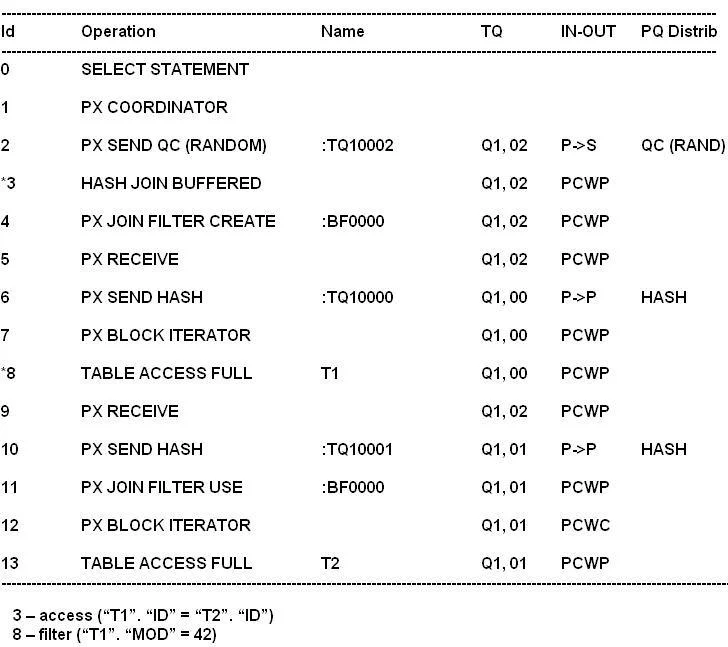
Examine the Exhibit. Which two statements are true about the bloom filter in the execution plan?
The correct answer is B. The bloom filter prevents all rows from table T2 that do not join table T1 from being needlessly distributed. F. The bloom filter is created in parallel by the set of parallel execution processes that scanned table T1. PX JOIN FILTER CREATE The bloom filter is created in line 4. PX JOIN FILTER USE The bloom filter is used in line 11. You can identify a bloom pruning in a plan when you see :BF0000 in the Pstart and Pstop columns of the execution plan and PART JOIN FILTER CREATE in the…
Understanding and Influencing the Optimizer
Question
Examine the Exhibit. Which two statements are true about the bloom filter in the execution plan?
Exhibit
Options
- AThe bloom filter prevents all rows from table T1 that do not join T2 from being needlessly distributed.
- BThe bloom filter prevents all rows from table T2 that do not join table T1 from being needlessly distributed.
- CThe bloom filter prevents some rows from table T2 that do not join table T1 from being needlessly distributed.
- DThe bloom filter is created in parallel by the set of parallel execution processes that scanned table T2.
- EThe bloom filter is created in parallel by the set of parallel execution processes that later perform join.
- FThe bloom filter is created in parallel by the set of parallel execution processes that scanned table T1.
How the community answered
(47 responses)- A15% (7)
- B72% (34)
- C2% (1)
- D6% (3)
- E4% (2)
Explanation
- PX JOIN FILTER CREATE The bloom filter is created in line 4. * PX JOIN FILTER USE The bloom filter is used in line 11. * You can identify a bloom pruning in a plan when you see :BF0000 in the Pstart and Pstop columns of the execution plan and PART JOIN FILTER CREATE in the operations column. * A Bloom filter is a probabilistic algorithm for doing existence tests in less memory than a full list of keys would require. In other words, a Bloom filter is a method for representing a set of n elements (also called keys) to support membership queries. * The Oracle database makes use of Bloom filters in the following 4 situations: - To reduce data communication between slave processes in parallel joins: mostly in RAC - To implement join-filter pruning: in partition pruning, the optimizer analyzes FROM and WHERE clauses in SQL statements to eliminate unneeded partitions when building the partition access list - To support result caches: when you run a query, Oracle will first see if the results of that query have already been computed and cached by some session or user, and if so, it will retrieve the answer from the server result cache instead of gathering all of the database blocks - To filter members in different cells in Exadata: Exadata performs joins between large tables and small lookup tables, a very common scenario for data warehouses with star schemas. This is implemented using Bloom filters as to determine whether a row is a member of the desired result
Topics
#bloom filter#parallel execution#parallel distribution#execution plan
Community Discussion
No community discussion yet for this question.