
Oracle
1Z0-117 · Question #4
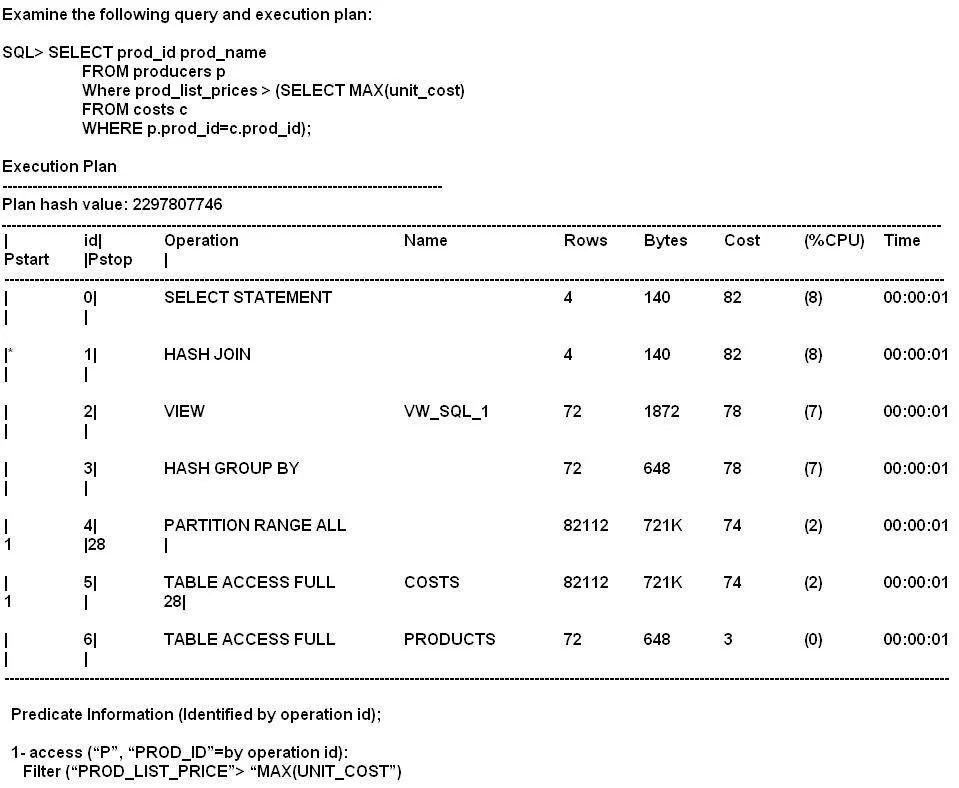
Examine the following query and execution plan: Which query transformation technique is used in this scenario?
The correct answer is A. Join predicate push-down. Normally, a view cannot be joined with an index-based nested loop (i.e., index access) join, since a view, in contrast with a base table, does not have an index defined on it. A view can only be joined with other tables using three methods: hash, nested loop, and sort-merge…
Understanding and Influencing the Optimizer
Question
Examine the following query and execution plan:
Which query transformation technique is used in this scenario?
Exhibit
Options
- AJoin predicate push-down
- BSubquery factoring
- CSubquery unnesting
- DJoin conversion
How the community answered
(43 responses)- A74% (32)
- B2% (1)
- C9% (4)
- D14% (6)
Explanation
- Normally, a view cannot be joined with an index-based nested loop (i.e., index access) join, since a view, in contrast with a base table, does not have an index defined on it. A view can only be joined with other tables using three methods: hash, nested loop, and sort-merge joins. * The following shows the types of views on which join predicate pushdown is currently UNION ALL/UNION view Outer-joined view Anti-joined view Semi-joined view
Topics
#query transformation#join predicate push-down#inline view#optimizer rewrites
Community Discussion
No community discussion yet for this question.