
1Z0-117 · Question #18
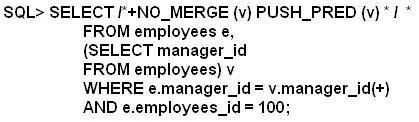
You execute the following query: Which statement is true about the usage of these hints in the query?
The correct answer is A. The optimizer pushes the join predicate into the inline view. The PUSH_PRED hint forces pushing of a join predicate into the view. SELECT /+ NO_MERGE(v) PUSH_PRED(v) / * FROM employees e, (SELECT manager_id WHERE e.manager_id = v.manager_id(+) AND e.employee_id = 100; When the PUSH_PRED hint is used without an argument, it should be…
Question
You execute the following query:
Which statement is true about the usage of these hints in the query?
Exhibit
Options
- AThe optimizer pushes the join predicate into the inline view.
- BThe optimizer evaluates the subquery as a first and then filters out rows.
- CThe optimizer performs a join operation first and then filters out the rows.
- DThe hint will have no effect because one of the join resultsets is an inline view.
How the community answered
(17 responses)- A71% (12)
- B6% (1)
- C6% (1)
- D18% (3)
Explanation
The PUSH_PRED hint forces pushing of a join predicate into the view. SELECT /*+ NO_MERGE(v) PUSH_PRED(v) */ * FROM employees e, (SELECT manager_id WHERE e.manager_id = v.manager_id(+) AND e.employee_id = 100; When the PUSH_PRED hint is used without an argument, it should be placed in the view query block. When PUSH_PRED is used with the view name as an argument, it should be placed in the surrounding query.
Topics
Community Discussion
No community discussion yet for this question.