
1Z0-117 · Question #122
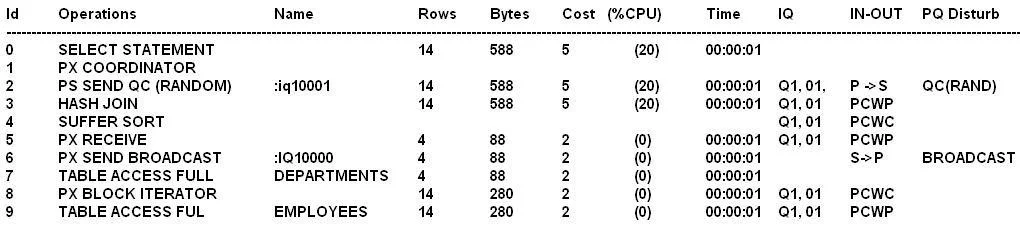
Examine the exhibit. Which is true based on the information obtainable from the execution plan?
The correct answer is E. A full table scan on the EMPLOYEES table is done in parallel. PX BLOCK ITERATOR This operation is typically the first step in a parallel pipeline. The BLOCK ITERATOR breaks up the table into chunks that are processed by each of the parallel servers B, C: The scan on the Departsments table is done in parallel. * As per exhibit: Line 7 is…
Question
Examine the exhibit. Which is true based on the information obtainable from the execution plan?
Exhibit
Options
- AA full partition-wise join performed between the EMPLOYEES and DEPARTMENTS tables.
- BA full table scan on the DEPARTMENTS table performed serially by the query coordinator.
- CA full table scan on the DEPARTMENTS table is performed serially by a single parallel execution server process.
- DA partial partition-wise join performed between the EMPLOYEES and DEPARTMENTS tables.
- EA full table scan on the EMPLOYEES table is done in parallel.
How the community answered
(49 responses)- A12% (6)
- B2% (1)
- C2% (1)
- D4% (2)
- E80% (39)
Explanation
PX BLOCK ITERATOR This operation is typically the first step in a parallel pipeline. The BLOCK ITERATOR breaks up the table into chunks that are processed by each of the parallel servers B, C: The scan on the Departsments table is done in parallel. * As per exhibit: Line 7 is run first, followed by line 6. Example with same structure of execution plan: Here's how to read the plan: 1. The first thing done is at line 9 ?an index fast full scan on SYS.OBJ$.I_OBJ1 index. This is done in parallel, as indicated from the "PX SEND" line above. 2. In line 8, we're doing a "PX SEND BROADCAST" operation. When joining tables in parallel, Oracle can choose to either broadcast results (rows) from one operation to apply to the other table scan, or it can choose PX SEND HASH. In this case, our CBO determined that a BROADCOAST was appropriate because the results from the OBJ$ table were much lower than 3. Line 7, the PX RECEIVE step, is basically the consumer of the broadcasted rows in step 8 4. Line 6 is an in-memory BUFFER SORT of the rows returned from the index scan on OBJ$ 5. Lines 11 and 10, respectively, indicate the full scan and PX BOCK ITERATOR operation for the granules involved in the 8 PQ servers 6. In line 5, Oracle is doing a hash join on the resulting rows from the parallel scans on MYOBJ 7. Line 4 is a per-PQ server sort of data from the joind PQ servers 8. Line 3 is the consumer QC that holds the result of the each of the PQ servers 9. Line 2 is the PX Coordinator (QC) collecting, or consuming the rows of the joined data 10. Line 1 is the final SORT AGGREGATE line that performs the grouping function
Topics
Community Discussion
No community discussion yet for this question.