
1Z0-117 · Question #114
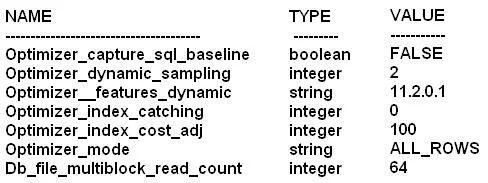
Examine the utilization parameters for an instance: You notice that despite having an index on the column used in the where clause, queries use full table scans with highly selective filters. What…
The correct answer is D. The OPTIMIZER_INDEX_COST_ADJ initialization parameter is set to 100. E. The blocks fetched by the query are greater than the value specified by the DB_FILE_MULTIBLOCK_. D: OPTIMIZER_INDEX_COST_ADJ lets you tune optimizer behavior for access path selection to be more or less index friendly--that is, to make the optimizer more or less prone to selecting an index access path over a full table scan. The default for this parameter is 100 percent…
Question
Examine the utilization parameters for an instance:
You notice that despite having an index on the column used in the where clause, queries use full table scans with highly selective filters. What are two possible reasons for the optimizer to use full table scans instead of index unique scans and index range scans?
Exhibit
Options
- AThe OPTIMIZER_MODE parameter is set to ALL_ROWS.
- BThe clustering factor for the indexes is high.
- CThe number of leaf blocks for the indexes is high.
- DThe OPTIMIZER_INDEX_COST_ADJ initialization parameter is set to 100.
- EThe blocks fetched by the query are greater than the value specified by the DB_FILE_MULTIBLOCK_
How the community answered
(41 responses)- A12% (5)
- B7% (3)
- C5% (2)
- D76% (31)
Explanation
D: OPTIMIZER_INDEX_COST_ADJ lets you tune optimizer behavior for access path selection to be more or less index friendly--that is, to make the optimizer more or less prone to selecting an index access path over a full table scan. The default for this parameter is 100 percent, at which the optimizer evaluates index access paths at the regular cost. Any other value makes the optimizer evaluate the access path at that percentage of the regular cost. For example, a setting of 50 makes the index access path look half as expensive as normal. E: DB_FILE_MULTIBLOCK_READ_COUNT is one of the parameters you can use to minimize I/O during table scans. It specifies the maximum number of blocks read in one I/O operation during a sequential scan. The total number of I/Os needed to perform a full table scan depends on such factors as the size of the table, the multiblock read count, and whether parallel execution is being utilized for the operation. As of Oracle Database 10g release 2, the default value of this parameter is a value that corresponds to the maximum I/O size that can be performed efficiently. This value is platform- dependent and is 1MB for most platforms.Because the parameter is expressed in blocks, it will be set to a value that is equal to the maximum I/O size that can be performed efficiently divided by the standard block size. Note that if the number of sessions is extremely large the multiblock read count value is decreased to avoid the buffer cache getting flooded with too many table scan buffers. Even though the default value may be a large value, the optimizer will not favor large plans if you do not set this parameter. It would do so only if you explicitly set this parameter to a large value. Online transaction processing (OLTP) and batch environments typically have values in the range of 4 to 16 for this parameter. DSS and data warehouse environments tend to benefit most from maximizing the value of this parameter. The optimizer is more likely to choose a full table scan over an index if the value of this parameter is high. * OPTIMIZER_MODE establishes the default behavior for choosing an optimization approach for The optimizer uses a cost-based approach and optimizes with a goal of best response time to return the first n rows (where n = 1, 10, 100, 1000). The optimizer uses a mix of costs and heuristics to find a best plan for fast delivery of the first few The optimizer uses a cost-based approach for all SQL statements in the session and optimizes with a goal of best throughput (minimum resource use to complete the entire statement).
Topics
Community Discussion
No community discussion yet for this question.