
1Z0-117 · Question #112
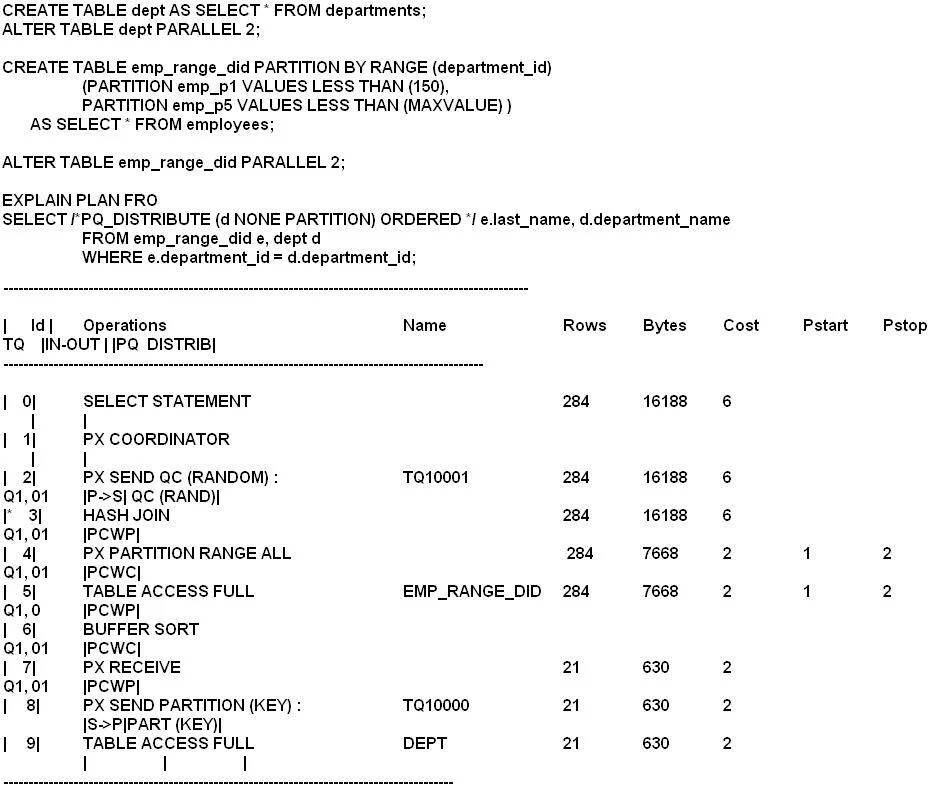
Examine the Exhibit. Which two options are true about the execution plan and the set of statements?
The correct answer is C. The DEPT table id dynamically distributed based on the partition keys of the EMP_RANGE_DID table. E. The query uses a full partition-wise join. Note the "px partition range all" in the execution plan. PX PARTITION RANGE (ALL) Parallel execution - iterate over all range partitioned table Full partition-wise joins can occur if two tables that are co-partitioned on the same key are joined in a query. The tables can be…
Question
Examine the Exhibit. Which two options are true about the execution plan and the set of statements?
Exhibit
Options
- AThe query uses a partial partition-wise join.
- BThe degree of parallelism is limited to the number of partitions in the EMP_RANGE_DID table.
- CThe DEPT table id dynamically distributed based on the partition keys of the EMP_RANGE_DID table.
- DThe server process serially scans the entire DEPT table for each range partition on the EMP_RANGE_DID
- EThe query uses a full partition-wise join.
How the community answered
(25 responses)- A4% (1)
- B8% (2)
- C84% (21)
- D4% (1)
Explanation
Note the "px partition range all" in the execution plan. * PX PARTITION RANGE (ALL) Parallel execution - iterate over all range partitioned table * Full partition-wise joins can occur if two tables that are co-partitioned on the same key are joined in a query. The tables can be co-partitioned at the partition level, or at the subpartition level, or at a combination of partition and subpartition levels. Reference partitioning is an easy way to guarantee co-partitioning. Full partition-wise joins can be executed serially and in parallel. * Oracle Database can perform partial partition-wise joins only in parallel. Unlike full partition-wise joins, partial partition-wise joins require you to partition only one table on the join key, not both tables. The partitioned table is referred to as the reference table. The other table may or may not be partitioned. Partial partition-wise joins are more common than full partition-wise joins. To execute a partial partition-wise join, the database dynamically partitions or repartitions the other table based on the partitioning of the reference table. After the other table is repartitioned, the execution is similar to a full partition-wise join.
Topics
Community Discussion
No community discussion yet for this question.