
1Z0-062 · Question #86
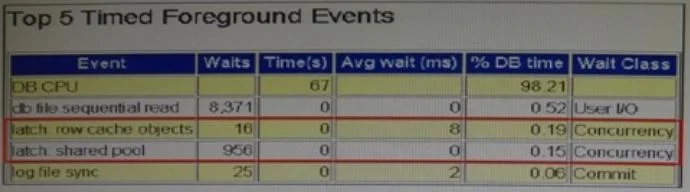
Examine the details of the Top 5 Timed Events in the following Automatic Workloads Repository (AWR) report: What are three possible causes for the latch-related wait events?
The correct answer is A. The size of the shared pool is too small. B. Cursors are not being shared. E. The buffers are being read into the buffer cache, but some other session is changing the buffers. Latch contention in Oracle appears in AWR reports when the shared pool is undersized, cursors are not reused, or buffer cache operations conflict between concurrent sessions.
Question
Examine the details of the Top 5 Timed Events in the following Automatic Workloads Repository (AWR) report:
What are three possible causes for the latch-related wait events?
Exhibit
Options
- AThe size of the shared pool is too small.
- BCursors are not being shared.
- CA large number COMMITS are being performed.
- DThere are frequent logons and logoffs.
- EThe buffers are being read into the buffer cache, but some other session is changing the buffers.
How the community answered
(57 responses)- A46% (26)
- C35% (20)
- D19% (11)
Why each option
Latch contention in Oracle appears in AWR reports when the shared pool is undersized, cursors are not reused, or buffer cache operations conflict between concurrent sessions.
A shared pool that is too small forces Oracle to perform frequent hard parses and evict cursors from the library cache. This causes high contention on the library cache and shared pool latches as multiple sessions simultaneously attempt to parse SQL and allocate or reclaim shared pool memory.
When cursors are not shared - typically because literals are used instead of bind variables - Oracle performs a hard parse for every unique SQL statement execution. This dramatically increases library cache latch contention because the latch must be held during each parse, preventing other sessions from accessing the library cache concurrently.
Frequent COMMITs primarily cause log file sync waits as sessions wait for LGWR to flush redo to disk, not latch-related contention events.
Frequent logons and logoffs create session-allocation overhead on the shared pool, but this manifests as CPU or library cache waits rather than the specific latch waits highlighted in an AWR Top 5 timed events section.
When a session reads blocks into the buffer cache while another session is concurrently modifying those same blocks, contention occurs on the cache buffers chains latch. This latch protects the linked list of buffers in each hash bucket of the buffer cache, and conflicting read/write operations force sessions to spin and wait for latch acquisition.
Concept tested: Oracle AWR latch contention root cause analysis
Source: https://docs.oracle.com/en/database/oracle/oracle-database/19/tgdba/tuning-shared-pool-and-large-pool.html
Topics
Community Discussion
No community discussion yet for this question.