
156-215.80 · Question #559
When should you generate new licenses?
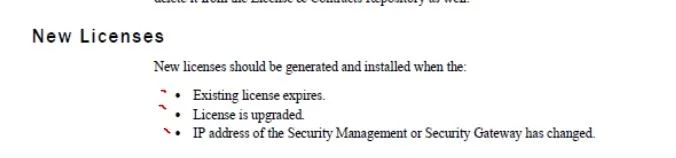
The correct answer is C. When the existing license expires, license is upgraded or the IP-address associated with the. New Check Point licenses must be generated when the existing license expires, when a license is upgraded, or when the IP address associated with the licensed gateway or management server changes.
Question
When should you generate new licenses?
Exhibit
Options
- ABefore installing contract files.
- BAfter a device upgrade.
- CWhen the existing license expires, license is upgraded or the IP-address associated with the
- DOnly when the license is upgraded.
How the community answered
(69 responses)- A3% (2)
- B1% (1)
- C90% (62)
- D6% (4)
Why each option
New Check Point licenses must be generated when the existing license expires, when a license is upgraded, or when the IP address associated with the licensed gateway or management server changes.
Contract files (support/maintenance contracts) are a separate object from licenses and are installed independently; license generation is not a prerequisite step before importing a contract file.
Software version upgrades do not invalidate a Check Point license as long as the gateway IP address and entitled features remain unchanged.
Check Point licenses are cryptographically bound to a specific IP address and to the entitled feature set. Any of these three conditions - expiration, feature upgrade, or IP address change - breaks the validity of the existing license and requires the administrator to log into the Check Point User Center, generate a fresh license, and install it via SmartConsole or the command line.
Restricting license regeneration to only upgrades is incomplete - expiration and IP address changes are equally common triggers that also mandate generating a new license.
Concept tested: Check Point license generation triggers and lifecycle management
Source: https://supportcenter.checkpoint.com/supportcenter/portal?eventSubmit_doGoviewsolutiondetails=&solutionid=sk33089
Topics
Community Discussion
4 Luis F.May 3, 2026
C is the right answer here. You generate new licenses when the existing one expires, when it gets upgraded, or when the IP address tied to it changes, because the license is bound to those specific conditions and a change in any of them invalidates the current one.
 Bao N.May 5, 2026
Right call, though on the exam watch out for distractors that try to fold "hardware change" into the IP scenario, because some question writers phrase it as a NIC swap or a DHCP reassignment and test whether you know those both count as address changes that break the binding.
Bao N.May 7, 2026Thought B was it, but license expiry plus IP change sealed C.
 Ingrid P.May 17, 2026
Option D is the classic trap here because people associate "generate new license" with upgrades and stop reading. The full trigger list is expiration, upgrade, OR IP address change, so C is the only answer that covers all three scenarios without arbitrarily leaving one out.