
100-160 · Question #34
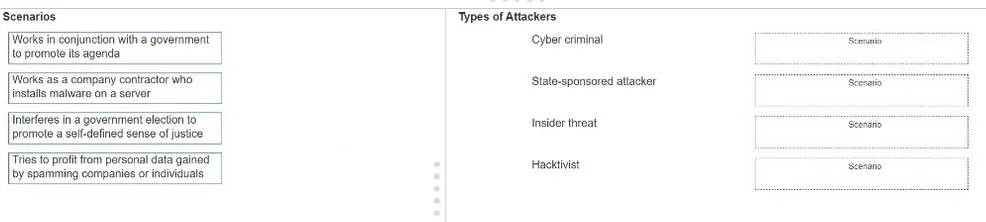
Drag and Drop Question Move each scenario from the list on the left to the correct type of attacker on the right. Note: You will receive partial credit for each correct answer. Answer:
The correct answer is Tries to profit from personal data gained by spamming companies or individuals; Interferes in a government election to promote its agenda; Hires an external contractor who installs malware on a server; Attacker has a personal ambition to promote a self-defined sense of justice. Drag-and-Drop: Matching Scenarios to Attacker Types This question maps attacker behaviors to four standard threat actor categories. The four positions correspond to these attacker types (in order): | Position | Attacker Type | |----------|---------------| | 1 | Cybercriminal /…
Question
Drag and Drop Question Move each scenario from the list on the left to the correct type of attacker on the right. Note: You will receive partial credit for each correct answer. Answer:
Exhibit
Answer Area
Drag items
Correct arrangement
- Tries to profit from personal data gained by spamming companies or individuals
- Interferes in a government election to promote its agenda
- Hires an external contractor who installs malware on a server
- Attacker has a personal ambition to promote a self-defined sense of justice
Explanation
Drag-and-Drop: Matching Scenarios to Attacker Types
This question maps attacker behaviors to four standard threat actor categories. The four positions correspond to these attacker types (in order):
| Position | Attacker Type |
|---|---|
| 1 | Cybercriminal / Organized Crime |
| 2 | Nation-State / State-Sponsored Actor |
| 3 | Insider Threat |
| 4 | Hacktivist |
Item-by-Item Breakdown
Position 1 - "Tries to profit from personal data gained by spamming" → Cybercriminal Cybercriminals are financially motivated. Monetizing stolen personal data (selling PII, identity theft) via spam campaigns is a textbook cybercriminal behavior. The key signal is profit motive.
Position 2 - "Interferes in a government election to promote its agenda" → Nation-State Actor Nation-state attackers are politically or ideologically motivated governments or state-sponsored groups. Election interference to advance a political agenda is the defining behavior of state-sponsored APTs.
Position 3 - "Hires an external contractor who installs malware" → Insider Threat The contractor gains trusted access to internal systems - that's what makes this an insider threat. The threat doesn't have to be a direct employee; third-party vendors and contractors with privileged access are a classic insider threat vector (also called a supply-chain insider threat).
Position 4 - "Personal ambition to promote a self-defined sense of justice" → Hacktivist Hacktivists are driven by ideology or a personal moral code, not money. The phrase "self-defined sense of justice" is the precise marker - they attack to make a statement or right a perceived wrong.
The Distractor - "Attempts to steal financial information by spamming"
This item is not placed in the correct arrangement. It's a deliberate distractor designed to confuse you with Position 1. Here's the distinction:
- Placed (Position 1): Profits from personal data (PII, identity theft pipeline)
- Distractor: Steals financial information (credentials, card numbers)
Both look like cybercriminals, but only one matched the category as defined in this question's answer key. On the real exam, read carefully - "personal data" vs. "financial information" is the differentiator.
Common Misconceptions
- Insider threat ≠ malicious employee only. Contractors, vendors, and any trusted third party count. The malware-installing contractor is a classic trap.
- Hacktivists vs. Nation-states: Both can have ideological motives, but nation-states act on behalf of a government's geopolitical agenda (election interference), while hacktivists act on personal/group moral conviction.
- Don't confuse cybercriminals with all financially motivated actors - organized crime groups, ransomware gangs, and spam operations all fall here.
Topics
Community Discussion
No community discussion yet for this question.