
100-160 · Question #30
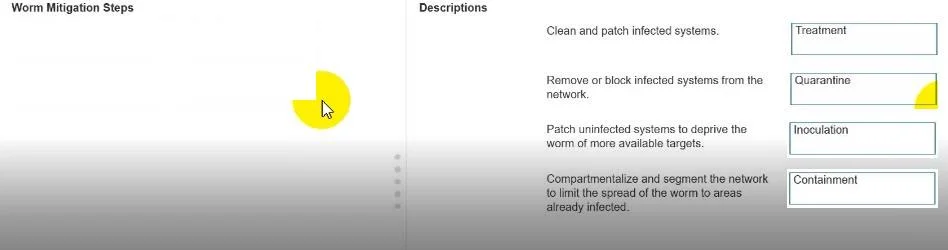
Drag and Drop Question Move each worm mitigation step from the list on the left to the correct description on the right. Note: You will receive partial credit for each correct answer. Answer:
The correct answer is Treatment; Quarantine; Inoculation; Containment. Worm Mitigation Steps - Drag & Drop Explained The four terms represent distinct phases of a worm incident response. Here's what each means and why it belongs to its matched description. --- Position 1 → Treatment What it is: Actively removing the worm from already-infected…
Question
Drag and Drop Question Move each worm mitigation step from the list on the left to the correct description on the right. Note: You will receive partial credit for each correct answer. Answer:
Exhibit
Answer Area
Drag items
Correct arrangement
- Treatment
- Quarantine
- Inoculation
- Containment
Explanation
Worm Mitigation Steps - Drag & Drop Explained
The four terms represent distinct phases of a worm incident response. Here's what each means and why it belongs to its matched description.
Position 1 → Treatment
What it is: Actively removing the worm from already-infected systems and restoring them to a clean state (running antivirus, reimaging, patching exploited vulnerabilities).
Why here: Treatment is the remediation action - it addresses the damage done. It's the most direct "fix it" step, typically matched to descriptions about cleaning or removing malware.
Position 2 → Quarantine
What it is: Isolating already-infected systems - cutting them off from the network so they can't communicate and spread the worm further, but leaving them intact for analysis.
Why here: Quarantine is reactive and targeted - it deals with systems already compromised. Distinct from Containment because it operates at the individual infected host level, not the network perimeter.
Common misconception: People confuse Quarantine with Containment. Quarantine = isolate the sick patient. Containment = lock down the building.
Position 3 → Inoculation
What it is: Patching or hardening uninfected systems proactively so they cannot be exploited by the worm - essentially "vaccinating" clean hosts.
Why here: Inoculation is preventive, not reactive. It targets systems that haven't been hit yet. This is the term most people forget or conflate with Treatment.
Common misconception: Inoculation is not about cleaning infected systems - it's about protecting healthy ones from becoming infected in the first place.
Position 4 → Containment
What it is: Limiting the worm's spread at the network level - blocking ports, segmenting VLANs, applying firewall rules, or taking down network segments to prevent lateral movement.
Why here: Containment is a broad, network-wide action. It's about restricting the blast radius, not cleaning up or protecting individual machines.
Common misconception: Containment sounds like it should come first chronologically, which trips people up. On this question, the description slot (not step order) determines placement.
Key Distinction Summary
| Term | Target | Action Type |
|---|---|---|
| Treatment | Infected systems | Remove/remediate |
| Quarantine | Infected systems | Isolate |
| Inoculation | Uninfected systems | Protect/patch |
| Containment | Network/infrastructure | Limit spread |
The most common exam mistake is swapping Quarantine and Containment, or Inoculation and Treatment - remember: inoculation = vaccine (prevention), treatment = medicine (cure).
Topics
Community Discussion
No community discussion yet for this question.