
XK0-005 · Question #480
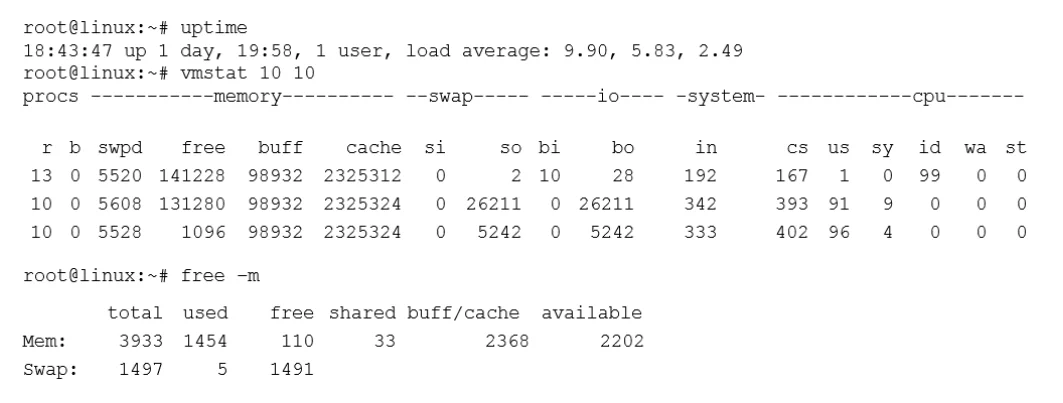
A Linux administrator was notified that a virtual server has an I/O bottleneck. The Linux administrator analyzes the following output: Given there is a single CPU in the sever, which of the…
The correct answer is B. The CPU is overloaded. With a single CPU, a tool like vmstat or top would show CPU metrics including wa (I/O wait). High I/O wait on a single CPU means the one CPU is spending most of its time waiting for disk I/O to complete, effectively making it overloaded. The I/O bottleneck manifests as CPU…
Question
A Linux administrator was notified that a virtual server has an I/O bottleneck. The Linux administrator analyzes the following output:
Given there is a single CPU in the sever, which of the following is causing the slowness?
Exhibit
Options
- AThe system is running out of swap space.
- BThe CPU is overloaded.
- CThe memory is exhausted.
- DThe processes are paging.
How the community answered
(22 responses)- A14% (3)
- B73% (16)
- C9% (2)
- D5% (1)
Explanation
With a single CPU, a tool like vmstat or top would show CPU metrics including wa (I/O wait). High I/O wait on a single CPU means the one CPU is spending most of its time waiting for disk I/O to complete, effectively making it overloaded. The I/O bottleneck manifests as CPU overload because the single processor cannot efficiently handle the volume of I/O requests queued against it. The other options (swap exhaustion, memory exhaustion, paging) would typically show different indicators in the output.
Topics
Community Discussion
No community discussion yet for this question.