
XK0-005 · Question #1488
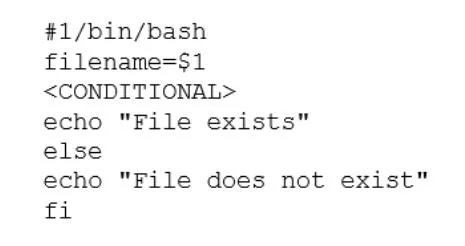
A user is asking the systems administrator for assistance with writing a script to verify whether a file exists. Given the following: Which of the following commands should replace the <CONDITIONAL>…
The correct answer is A. if [ -f "$filename" ]; then. The command if [ -f "$filename" ]; then checks if the variable $filename refers to a regular file that exists. The -f option is used to test for files. If the condition is true, the commands after then are executed. This is the correct way to replace the <CONDITIONAL> string…
Question
Exhibit
Options
- Aif [ -f "$filename" ]; then
- Bif [ -d "$filename" ]; then
- Cif [ -f "$filename" ] then
- Dif [ -f "$filename" ]; while
How the community answered
(43 responses)- A88% (38)
- B2% (1)
- C7% (3)
- D2% (1)
Explanation
The command if [ -f "$filename" ]; then checks if the variable $filename refers to a regular file that exists. The -f option is used to test for files. If the condition is true, the commands after then are executed. This is the correct way to replace the <CONDITIONAL> string. The other options are incorrect because they either use the wrong option (-d tests for directories), the wrong syntax (missing a semicolon after the condition), or the wrong keyword (while is used for loops, not
Topics
Community Discussion
No community discussion yet for this question.