
XK0-004 · Question #476
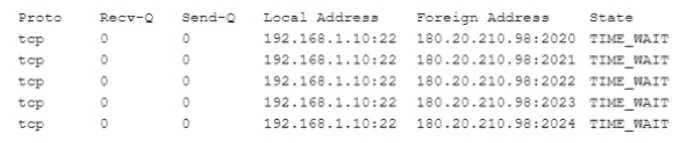
A systems administrator is reviewing the following partial output: Which of the following should the administrator use to find contact information for the connections?
The correct answer is A. tcpdump -Invi eth0 host 180.20.210.98 and pore 80. The marked answer A (tcpdump -Invi eth0 host 180.20.210.98 and pore 80) is almost certainly an error in the answer key. tcpdump is a packet capture tool used to inspect network traffic - it does not retrieve contact or ownership information for an IP address. Additionally…
Question
A systems administrator is reviewing the following partial output:
Which of the following should the administrator use to find contact information for the connections?
Exhibit
Options
- Atcpdump -Invi eth0 host 180.20.210.98 and pore 80
- Bwhois $(dig -x 180.20.210.98 +short)
- Cnslookup -query MX 180.20.210.98
- Dtracert, -d 180.20.210.98
- Ehost 180.20.210.98 I sendmail
How the community answered
(28 responses)- A79% (22)
- B4% (1)
- C7% (2)
- E11% (3)
Explanation
The marked answer A (tcpdump -Invi eth0 host 180.20.210.98 and pore 80) is almost certainly an error in the answer key. tcpdump is a packet capture tool used to inspect network traffic - it does not retrieve contact or ownership information for an IP address. Additionally, 'pore' is a typo for 'port'. Option B (whois $(dig -x 180.20.210.98 +short)) is the correct approach: dig -x performs a reverse DNS lookup to resolve the IP to a hostname, and whois then queries the domain registration database to return contact information (registrant, abuse contact, etc.). This is the standard administrative method for identifying who owns or is responsible for a given IP address.
Topics
Community Discussion
No community discussion yet for this question.