
XK0-004 · Question #412
While booting an Intel 64-bit Debian UEFI desktop from power up, the prompt ts0> was displayed, indicating the bootloader failed. Which of the following will complete the boot process to a GRUB2 menu?
The correct answer is B. Option B. When GRUB2 fails on a UEFI system and drops to a rescue prompt, the correct commands manually set the root partition and prefix path, then load the 'normal' module to display the GRUB2 menu.
Question
While booting an Intel 64-bit Debian UEFI desktop from power up, the prompt ts0> was displayed, indicating the bootloader failed. Which of the following will complete the boot process to a GRUB2 menu?
Exhibit
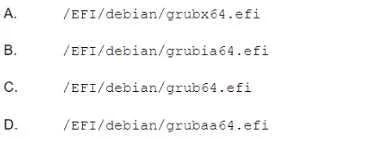
Options
- AOption A
- BOption B
- COption C
- DOption D
How the community answered
(14 responses)- A7% (1)
- B57% (8)
- C14% (2)
- D21% (3)
Why each option
When GRUB2 fails on a UEFI system and drops to a rescue prompt, the correct commands manually set the root partition and prefix path, then load the 'normal' module to display the GRUB2 menu.
Option A likely specifies incorrect partition identifiers or an incomplete command sequence that would fail to load the 'normal' module and restore the GRUB2 menu.
From a GRUB2 rescue prompt, Option B correctly uses 'set root=(hdX,gptY)', 'set prefix=(hdX,gptY)/boot/grub', and 'insmod normal' followed by 'normal' to locate the GRUB2 files, load the full GRUB2 environment, and present the boot menu. This is the documented recovery sequence for a UEFI GRUB2 rescue shell where the bootloader lost its path references.
Option C likely uses wrong device paths or incorrect GRUB2 module references that do not correspond to the UEFI partition layout, preventing successful boot menu display.
Option D likely contains commands appropriate for a legacy BIOS GRUB environment or incorrect syntax that is incompatible with the UEFI GRUB2 rescue context.
Concept tested: GRUB2 UEFI rescue prompt manual boot recovery
Source: https://www.gnu.org/software/grub/manual/grub/grub.html#GRUB-only-offers-a-rescue-shell
Topics
Community Discussion
No community discussion yet for this question.